
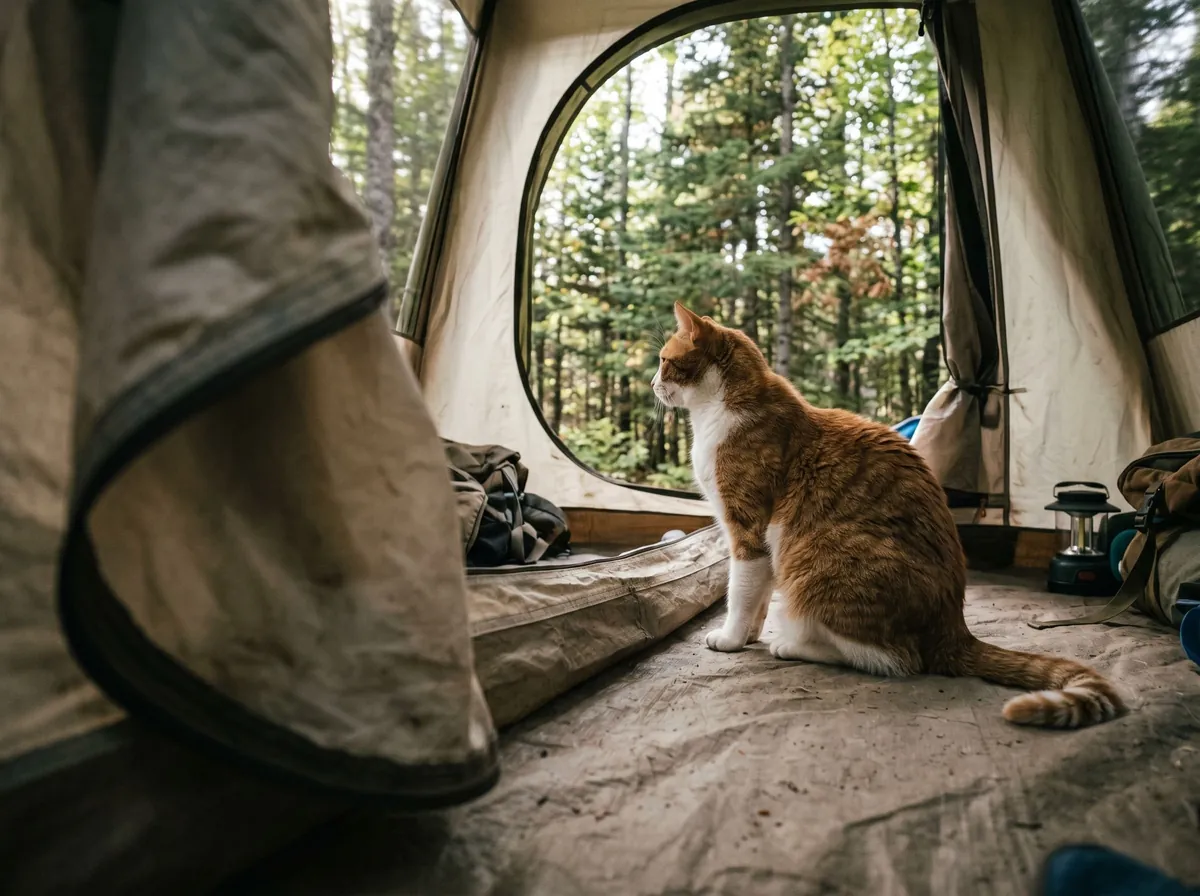
If you have ever watched your cat bolt under the bed at the sound of a plastic bag, you have probably paused before booking that camping trip. A tent at night — with wind, wildlife sounds, and no familiar territory — is a different world entirely.
Some cats handle it remarkably well. Others should never go. Before booking a campsite, use the checker below to find out which category your cat falls into.
Is Your Cat Ready to Camp?
Takes two minutes to find out if your cat will love it — or hate every second.
Preparing Your Cat for the First Trip
Passing the readiness check is the starting line, not the finish. Two things need to happen before your cat is ready to camp: a vet clearance, and a staged acclimation process that takes months.
Before Going Camping: The Vet Check
A vet check comes first and is not optional. Your cat must be free of underlying medical conditions, osteoarthritis, or chronic pain — physical discomfort dramatically amplifies anxiety in novel environments . It also needs current vaccinations and broad-spectrum parasite prevention before any outdoor exposure.
Clearing the vet check does not mean your cat is ready to camp. It means your cat is healthy enough to begin the gradual exposure process that actually prepares for it.
Acclimation Takes Months, Not Days
Research on cats introduced to novel environments found they spent 55% of their time hiding during the first two weeks. The progression to a campsite must be measured in months, not days.
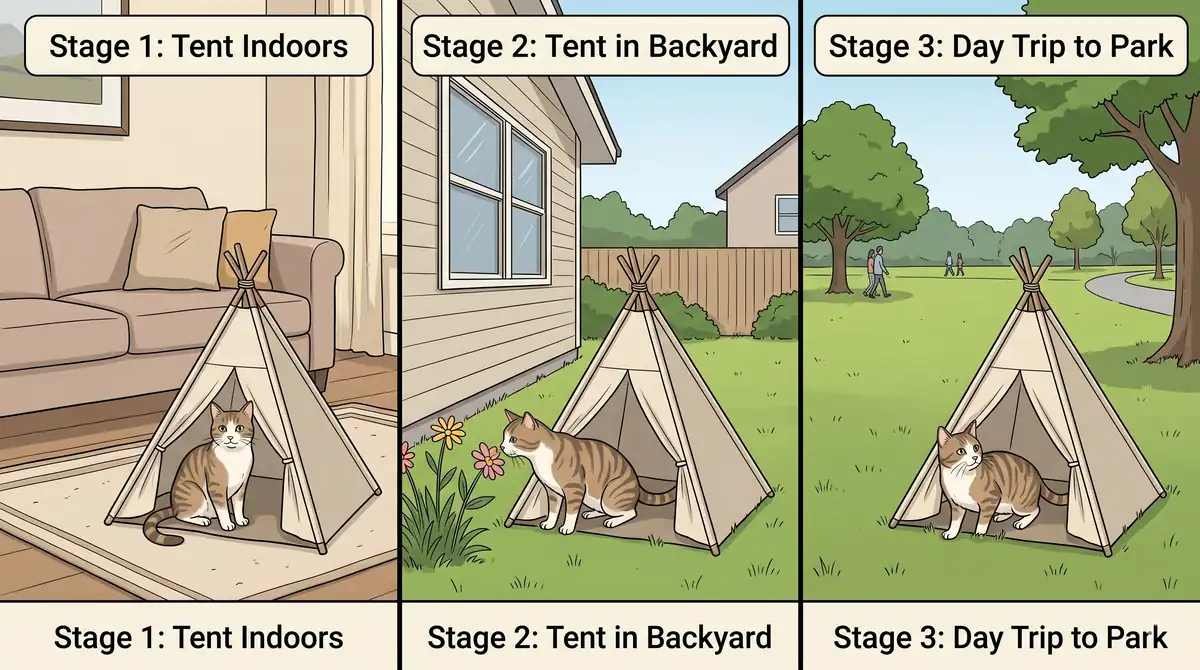
Stage one: erect the tent inside your home for several weeks. The cat deposits facial pheromones on the fabric and begins to treat it as familiar territory. Stage two: move the tent to the backyard — outdoor sounds and scents, anchored to home. If your cat hides continuously or refuses food, stop.
Stage three: a day trip to a quiet park — your cat must already tolerate the full harness walk outdoors before this stage. Only after that succeeds should a single overnight trip close to home be attempted.
What Makes a Tent Safe for Cats?
Most tent failures happen not because owners chose the wrong campsite, but because they chose the wrong tent.
Mesh on the Lower Walls Will Get Shredded
Standard tent insect mesh shreds under feline claws. A cat confined overnight, particularly one hearing wildlife outside, will scratch — and the mesh will not survive it. Select a tent with solid high-denier fabric on the lower walls and mesh restricted to the upper canopy, out of reach.
One Person With a Cat Needs a Two-Person Tent
A single camper with one cat needs a two-person tent at minimum. The extra floor space keeps the litter box, sleeping area, and feeding station physically apart. Without that separation, resource guarding anxiety adds to an already stressful environment.
An Unclipped Zipper Is an Open Door
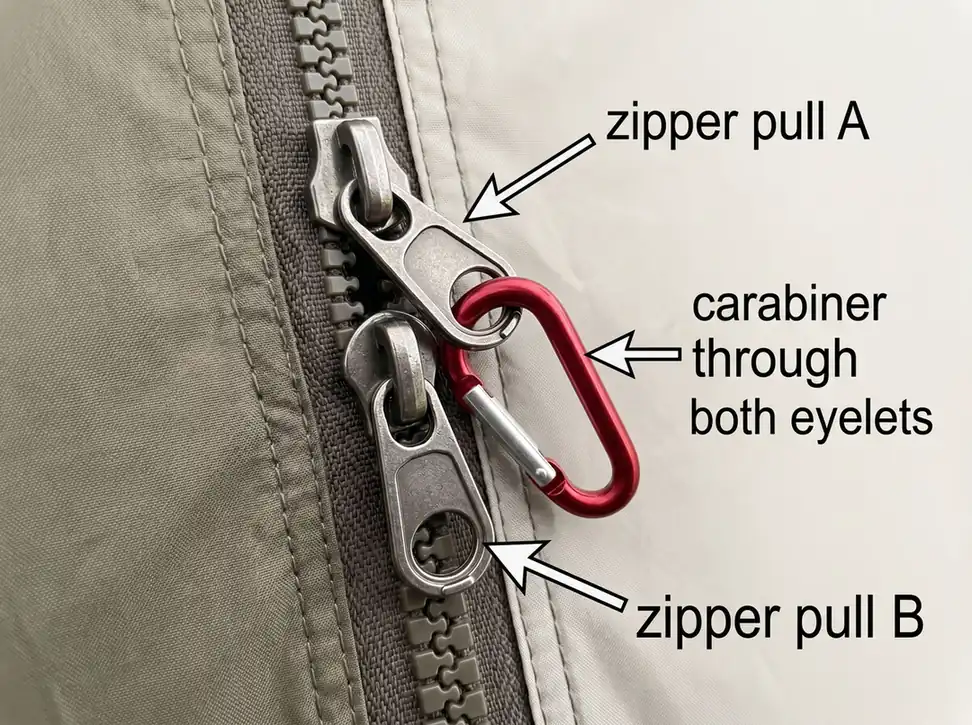
Cats have the paw dexterity and associative learning ability to nudge dual zipper pulls apart from the inside . Once a small gap opens, a determined cat can force through it. This is the most documented overnight failure mode in cat camping — and the easiest to prevent.
Draw both zipper pulls completely together and clip a small metal carabiner through the eyelets of both pull tabs. The carabiner physically prevents the sliders from separating along the track. Animal transport protocols use the same mechanical principle to secure enclosure doors during transit. It takes ten seconds and eliminates the failure mode entirely.
Where Should Your Cat Sleep Overnight?
There is no single right answer here — the best option depends on your cat’s temperament, the overnight temperature, and how secure your tent is. The table below lays out the tradeoffs across the three realistic options.
| Tent (unrestrained) | Car (unrestrained) | Crate (inside tent or car) | |
|---|---|---|---|
| Escape risk | High — depends entirely on zipper security and fabric integrity | Medium — secure structure, but risk spikes when doors open | Low — locking mechanism provides mechanical containment |
| Temperature control | Poor — tent interior matches ambient temperature rapidly | Dangerous — acts as solar oven by day, retains cold at night | Moderate — restricted volume holds radiant body heat better |
| Litter access | Excellent — floor space allows a box kept well away from the sleeping area | Good — footwell or cargo area accommodates a box | Poor — standard crates lack space for both sleeping and elimination |
| Cat comfort | High — allows pacing, stretching, and co-sleeping with owner | Moderate — freedom of movement, but isolated from owner | Variable — restricts movement, though the enclosed space reduces anxiety in some cats |
Free roaming in the tent offers the highest comfort and uninterrupted litter access — but only if the zipper is carabiner-locked and the lower walls are solid fabric. A crash-tested crate inside the tent eliminates escape risk entirely, though it requires actively managing your cat’s elimination schedule overnight .
Where Does the Litter Box Go at Camp?
The litter box must stay inside the tent or vehicle at all times — never outside, never exposed at the campsite. Cat feces and urine carry territorial pheromones that draw feral cats and wild felids into a defensive, aggressive mode. Organic waste odor also attracts opportunistic animals like raccoons and bears.
Solid waste should be scooped immediately, sealed in an airtight bag, and disposed of in a bear-proof receptacle. This is a wildlife safety measure and a legal requirement under Leave No Trace principles on most public lands.
How Cold or Hot Is Too Much for Cats?
A tent is not a shelter from temperature — it is a membrane. The temperature risks in RV camping follow the same logic, but tents offer even less protection. Below 45°F, your cat is fighting hypothermia. Above 75°F in direct sun with the tent closed, your cat is in a greenhouse.
Below 45°F, Your Cat Needs Active Warming
The domestic cat’s thermoneutral zone sits between 86°F and 100°F (30–38°C) — significantly higher than most people assume . Veterinary guidelines advise against exposing indoor cats to temperatures below 45°F (7°C). For kittens, seniors, and single-coat breeds, that limit is higher.
Tents do not insulate. On a cold night, the interior temperature will converge with the ambient air within an hour. An insulated crate, an outdoor-rated heating pad, or sharing a sleeping bag are not optional extras — they are the difference between your cat maintaining core temperature and entering hypothermia.
A Closed Tent in the Sun Can Kill Your Cat
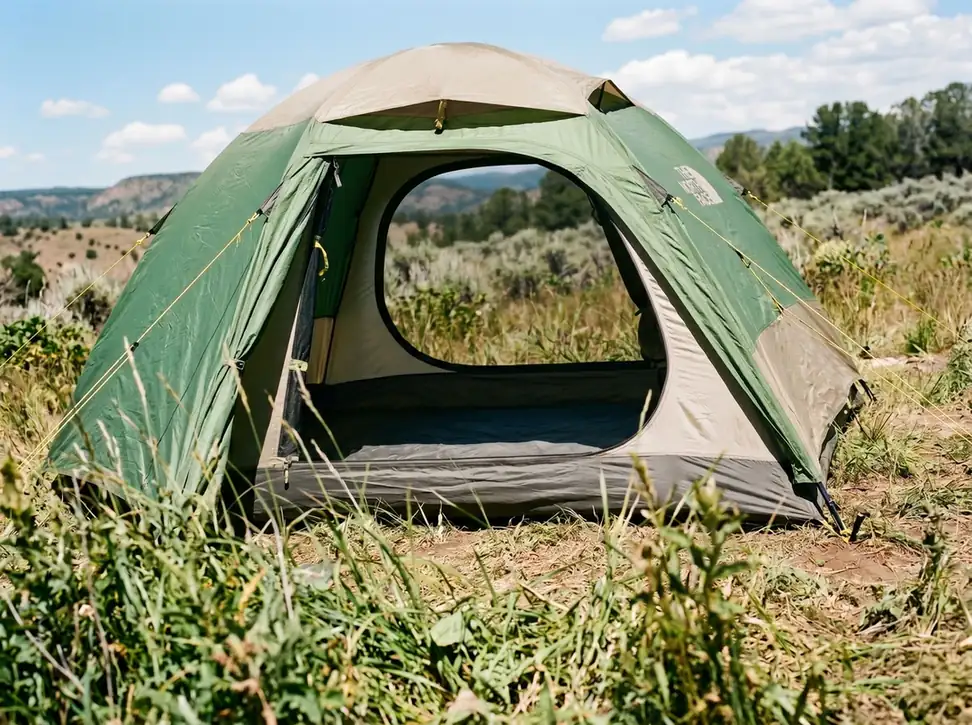
A closed tent behaves like a parked car. Shortwave solar radiation passes through the fabric, is absorbed by the interior, and is re-radiated as heat that cannot escape. On a 75°F (24°C) day, the interior of a closed tent can exceed lethal temperatures within minutes.
The warning signs of heatstroke escalate fast: heavy panting and drooling first, then lethargy, vomiting, and collapse. If your cat begins panting heavily, move your cat immediately to shade, apply room-temperature water to its fur, and evacuate to the nearest emergency vet. Do not use ice water — it constricts surface blood vessels and slows heat dissipation.
What to Do If Your Cat Escapes?
The first instinct when a cat bolts is to run after them. That instinct is wrong — and acting on it is the most common reason campsite escapes turn into multi-day searches.
The First 10 Minutes: Walk, Don’t Chase
When cats slip their harness or push through a zipper gap, they are not running away — they are fleeing a perceived threat. If you run toward them, you become that threat. Feline prey-flight response is hardwired: a human charging forward will push your cat deeper into cover, fast .
Stop moving. Lower yourself to the ground or crouch. Use a calm, familiar voice — your cat’s name, or the sound it associates with food. Shaking a treat bag or tapping a wet food can travels further than a voice and triggers a conditioned response even in a panicked cat. The goal in the first ten minutes is not to catch your cat. It is to stop them from running further.
Where Escaped Cats Actually Hide at Campgrounds
A displaced cat does not run for the trees. It looks for the nearest enclosed space and goes silent . Research on lost cat behavior shows that 92% of displaced indoor-only cats are recovered within 150–200 yards of their escape point — well within the campsite boundary.
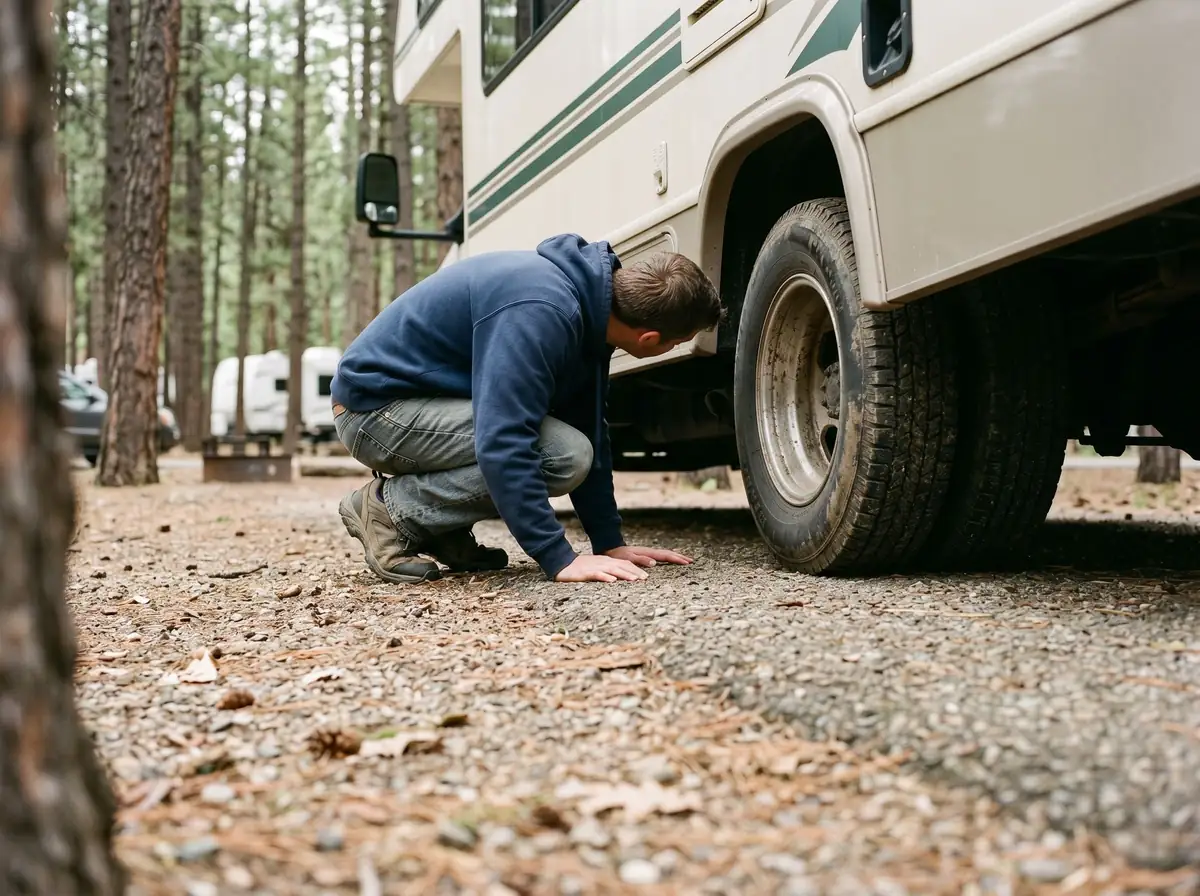
The most documented hiding spots are under root systems, inside hollow logs, and in the mechanical undercarriage of the owner’s vehicle — wheel wells, axles, and spare tire cavities. Check the car first, on hands and knees, before expanding the search radius. A terrified cat will not meow even if you are standing three feet away, so a visual search is the only reliable method.
Which Cat GPS Tracker Works?
All tracking collars are not the same technology. Matching the tracker to the geography of your campsite is what determines whether it actually works during an escape.
| Cellular GPS (e.g. Tractive) | Bluetooth (e.g. AirTag) | RF (e.g. Tabcat v2) | |
|---|---|---|---|
| How it works | GPS satellites + cellular network | Bluetooth beacon relayed by nearby Apple devices | Direct 2.45GHz radio signal between tag and handheld receiver |
| Range | Worldwide — if cellular signal exists | ~30–50 ft from a passing Apple device | ~500 ft (152 m) |
| Accuracy | ~8 m in open space | Location of nearest relay device | Down to 2.5 cm |
| Forest canopy | Fails — tree cover blocks satellite line-of-sight | Fails — no passing iPhones in remote wilderness | Works — RF penetrates undergrowth and solid objects |
| Cellular required | Yes | No, but needs Apple device density | No |
For remote wilderness camping, Bluetooth and cellular GPS both provide a false sense of security. RF is the only technology that functions reliably off-grid .
The Layered Tracking Setup
No single device is sufficient. Batteries die, signals fail, and collars come off in dense brush. Veterinary preparedness protocols call for three tracking layers working simultaneously.
The active layer is the RF tracker, mounted on a breakaway collar or harness. The passive layer is a physical ID tag with your mobile number and campsite or license plate — any hiker or ranger who finds your cat can return them without specialist equipment.
The permanent layer is a subcutaneous microchip. It carries no signal and cannot locate a running cat. But if your cat loses its collar in the brush and surfaces at a shelter days later, it links them back to you through national databases.
Essential Gear Checklist
Tent-Specific Gear
Beyond your usual camping kit, four items are specific to camping with a cat:
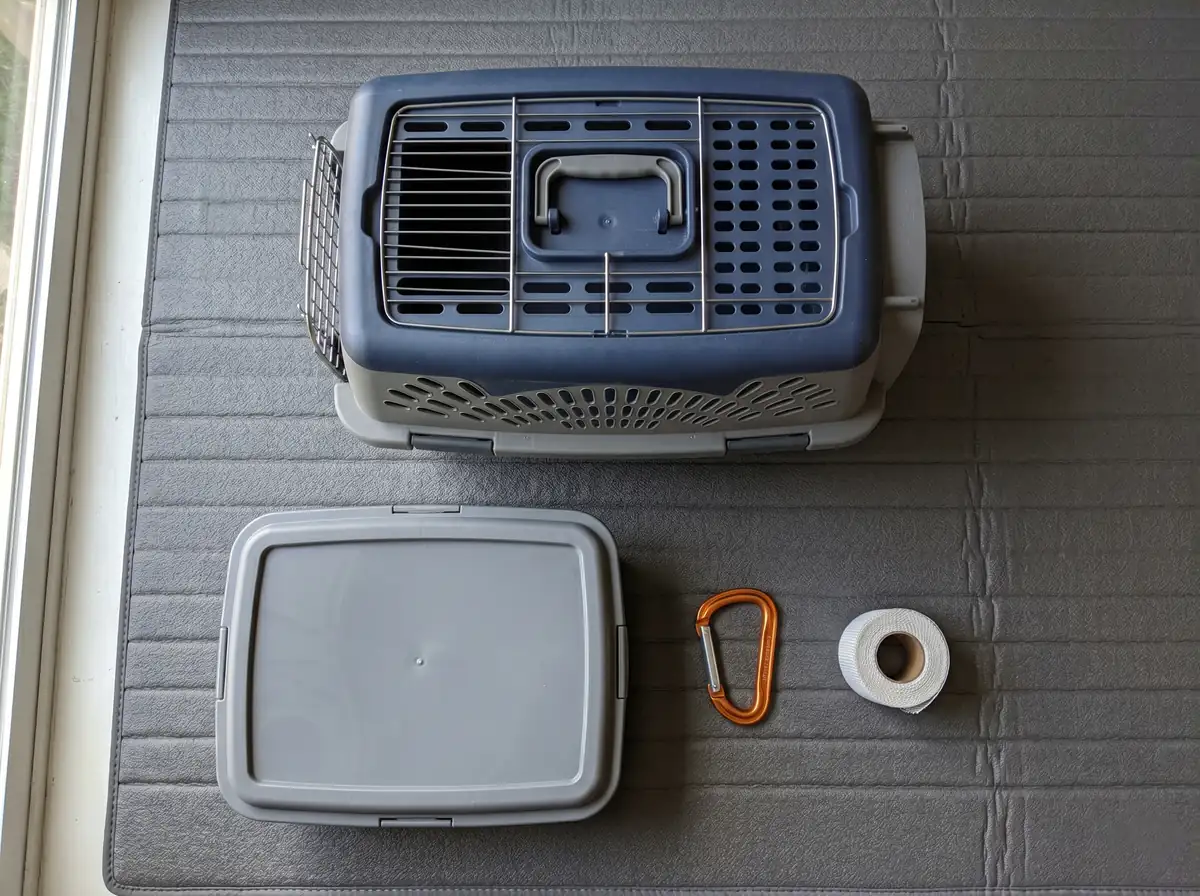
- Locking carabiners — small zinc-alloy clips threaded through both zipper pull eyelets to prevent the sliders from separating overnight
- Portable litter system — a compact, lidded box that contains odor inside the tent and keeps pheromones from reaching wildlife outside
- Mesh repair tape — heavy-duty adhesive patches for immediate field repair of any scratched-through panels
- Crash-tested carrier — a safety-rated mobile pet bed (rip-stop mesh, luggage-grade zippers) that doubles as a containment option inside the tent overnight
Safety Layer
The AVMA’s pet travel preparedness guidelines call for two categories of safety gear: preventative hardware and a reactive medical kit .
Preventative hardware:
- Escape-proof body harness
- RF tracker mounted to the harness
- LED collar attachment for nighttime visibility
Reactive medical kit (waterproof bag):
- Digital thermometer — for assessing hypothermia or heatstroke
- Blunt scissors and tweezers — for bandaging and tick or thorn removal
- Sterile gauze and self-adhering bandage wrap
- Saline solution — for flushing eyes or wounds
- Disposable gloves
- 3% hydrogen peroxide — only under direct guidance from a poison control center if toxic ingestion is suspected
None of these items is heavy or expensive. Together, they cover the three failure modes that send cat camping trips to emergency vets: temperature extremes, escape injuries, and toxic ingestion.
TL;DR
- Not every cat is a candidate. A cat who panics in a carrier or during short car rides should not go — stressor stacking in a wilderness environment makes things worse, not better.
- Your tent matters more than you think. Lower-wall mesh will get shredded. One person with one cat needs a two-person tent. Every zipper needs a carabiner clip.
- GPS trackers fail under tree canopy. Cellular GPS and Bluetooth both stop working off-grid. RF is the only technology that reliably functions in a forest.
- Below 45°F, active warming is required. Above 75°F with a closed tent in direct sun, you have minutes before conditions become dangerous.
- If your cat escapes, stop running. Crouch down, use your cat’s food recall sound, and check the car undercarriage first — 92% of displaced cats are found within 200 yards of where they escaped.
Frequently Asked Questions
What cat camping accessories do I actually need beyond the basics?
A carrier that doubles as a safe haven at the campsite — rip-stop fabric, self-locking zippers, bonded to at home before the trip . A dedicated first-aid kit is the second non-negotiable. Everything else is in the gear checklist above.
Can I practice tent camping with my cat indoors first?
Yes — veterinary behaviorists recommend it. Setting up the tent indoors lets your cat investigate and deposit facial pheromones on the fabric without the stressors of travel. By the time the tent reaches the campsite, it already smells like home.
Can I leave my cat alone at the campsite while I hike?
No. On NPS land it is prohibited under 36 CFR § 2.15. A cat locked in a tent faces the greenhouse effect. A cat tied outside is immobile and exposed to predators. There is no safe version of leaving your cat alone.
Will my cat destroy my tent overnight?
Probably, if your cat is anxious or hears movement outside. Scratching is a physiological need — cats target fabric when stressed . Solid lower-wall fabric and a carabiner-locked zipper reduce the risk. Mesh repair tape handles the rest.
Is it too late to train my adult cat for camping?
No. Adult cats can form new associations through positive reinforcement — the timeline is longer than with kittens, but the same staged process applies. Expect months, not weeks.
