
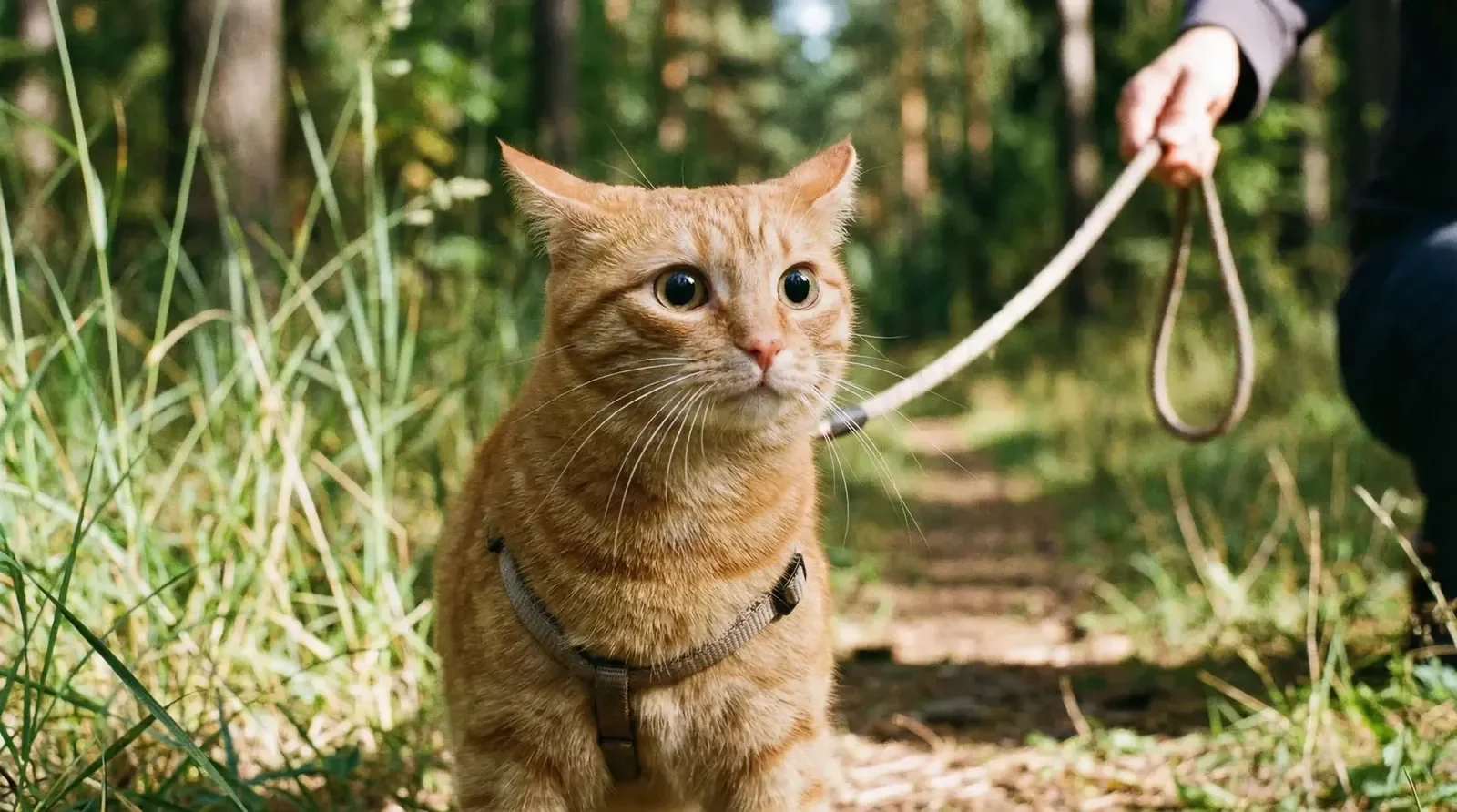
You bought a better harness. You did the research. You chose the Travel Cat over the cheap Petsmart one, you checked the fit, you took it slow — forty-five minutes outside yesterday, and she was loving every second of it.
Then today, without warning, she started launching herself into the air like a grasshopper. Three jumps. Four. And then the harness was on the ground and she was sprinting toward the shed, and you were standing there holding an empty leash.
This is not a freak event. This is the predictable endpoint of a system that looks secure until the exact moment it isn’t.
Key Takeaways
-
Harness escapes are a physics problem, not a training problem. Cats have a floating collarbone that lets them shrink their shoulder width when they pull backward — and that defeats any harness built on fixed strap geometry.
-
59% of cats show measurable stress during transport — meaning your cat arrives at the trail already wound up and one bad smell away from a full panic. The threshold for a bolt is lower than you think.
-
Pulling back on the leash when your cat bolts is the worst thing you can do. It gives her the resistance she needs to push the harness right off her body.
-
No harness is escape-proof. The goal is layers: better gear, precise fit, trained handling, and a backup tracker.
The Physics Behind Every Harness Escape
The Floating Collarbone: Why Cat Bodies Are Built to Escape
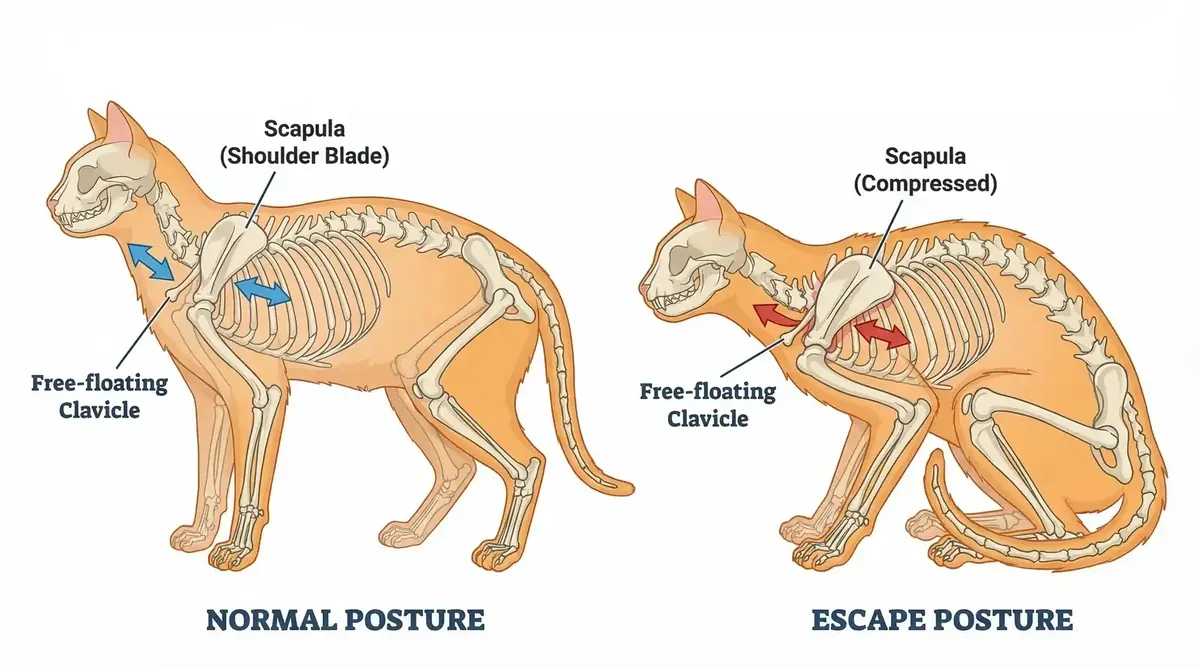
The domestic cat is a hunter built for squeezing through tight spaces. Unlike humans, a cat’s front legs attach to the shoulder through a collarbone that floats free — buried in muscle rather than locked to the chest like ours. This means cats can actively pull their shoulder blades inward on demand, and pass their body through any gap their head can fit through.
The practical consequence: when a harness puts pressure on a cat that’s backing away, her skeleton physically narrows. The fit that was correct thirty seconds ago no longer matters. She has changed the shape of the body the harness was built around.
This is the physical reality that no amount of “escape-proof” marketing language actually solves. The freeze-and-flop you see when first putting a harness on a cat? Same system. The cat’s nervous system detects pressure on her back and triggers an instinctive “go limp” response. When panic overrides that freeze, the shoulder-compression kicks in instead.
Why Panic Is the Trigger — Not Stubbornness
When a cat encounters something threatening outside, her brain floods her body with stress hormones. This is not a decision she makes. It is a reflex she cannot override.
The critical piece is the opposition reflex — the hardwired drive to pull hard against any physical pressure rather than give in to it. A taut leash pushes toward her head. Her nervous system reads this as a trap and pulls directly back against it. Combined with those compressible shoulders, this creates a neat mechanical trick: the leash itself becomes the escape tool. She uses the tension as a brace and levers the harness forward off her body.
Over 67% of cats show severe anxiety signs during transport and new environments. Panic is the statistical norm, not the edge case. Any harness needs to be evaluated on a thrashing, terrified cat — not one walking calmly forward on a sunny afternoon.
The Harnesses That Fail and the Ones That Don’t
H-Style and Figure-8: Why They’re Structurally Compromised
The H-style harness and the figure-8 are the two most common types sold in pet stores. Both have the same fundamental problem: they rely on thin straps that a cat can work around once she knows how.
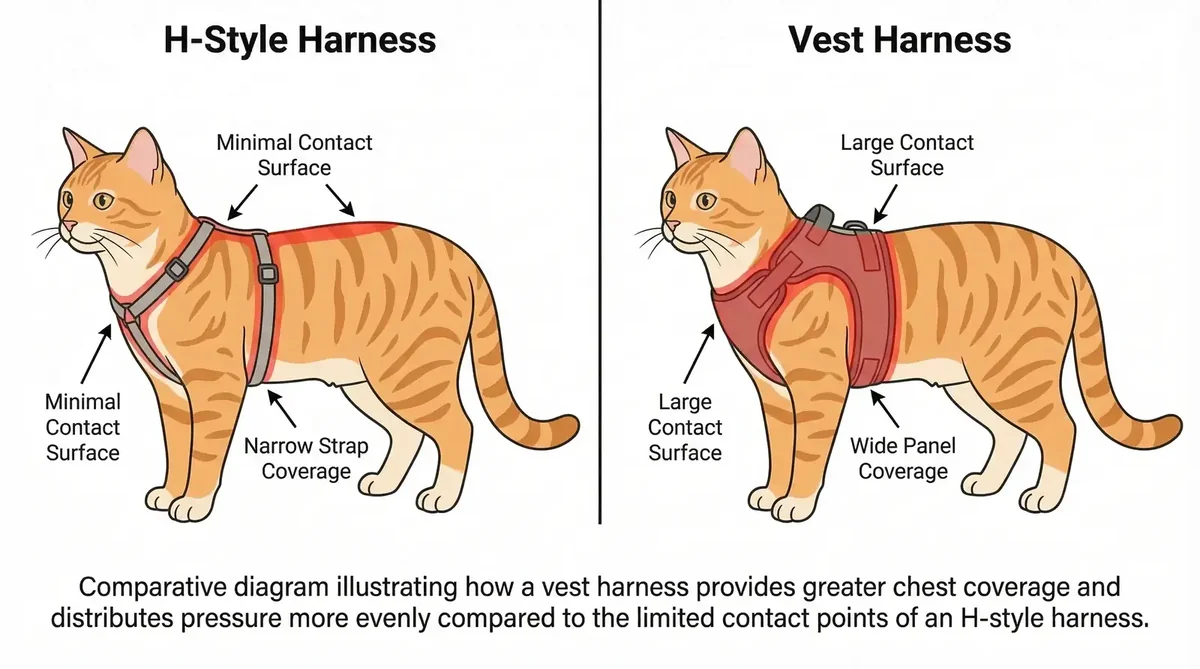
The H-style fails through its armpit gap. These minimalist designs have no chest panel or sternum plate. When a cat backs up, the leash pulls the belly strap forward. The cat tucks her elbows inside that strap, it slides up the torso, and she walks out of the neck loop. The flaw is built into the design — wide open armpits that can’t account for active shoulder compression.
The figure-8 has a different problem. It holds its shape only when the leash is tight. The moment you take a step toward your cat and the line goes slack, the whole thing loosens. A cat’s narrow head can slide through that enlarged neck opening in under two seconds.
Two more categories to avoid entirely: any harness with breakaway buckles on the main body (they’re designed to release under force — exactly what a panicking cat creates), and any harness held together mainly by Velcro (it can’t withstand the sudden, explosive force of a bolting cat).
“Escape proof cat harness” is a marketing phrase. It is not an engineering specification.
What a Genuinely Escape-Resistant Harness Actually Looks Like
Escape resistance comes from surface area and wrap coverage — not from tighter straps.
The best option in the adventure cat world is the broad-chested vest harness. It’s a full wrap design that spreads pressure across the entire chest and back, rather than concentrating it on two thin straps. With more fabric covering more body, there are no discrete armpit gaps to exploit. A cat shoulder can slip past a narrow strap. It cannot compress through a solid panel of fabric.
A secondary option is the martingale-style cat harness, which has a dynamic loop on the back. When a cat tries to back out, the loop tightens slightly — not painfully, but just enough to close off the armpit gap she’s trying to use. Her own escape attempt works against her. It’s a clever design: it uses the cat’s force to stop the escape rather than relying on static straps to hold her in place.
When evaluating any harness, the test is simple: can you find an armpit gap? If you can, your cat already has.
Fit Is a Skill, Not a Setting — How to Size Your Cat’s Harness Correctly
The Two-Finger Test and What It Actually Checks
Harness fit is not a measurement you take once at the store. It is a quick check you do before every single walk.
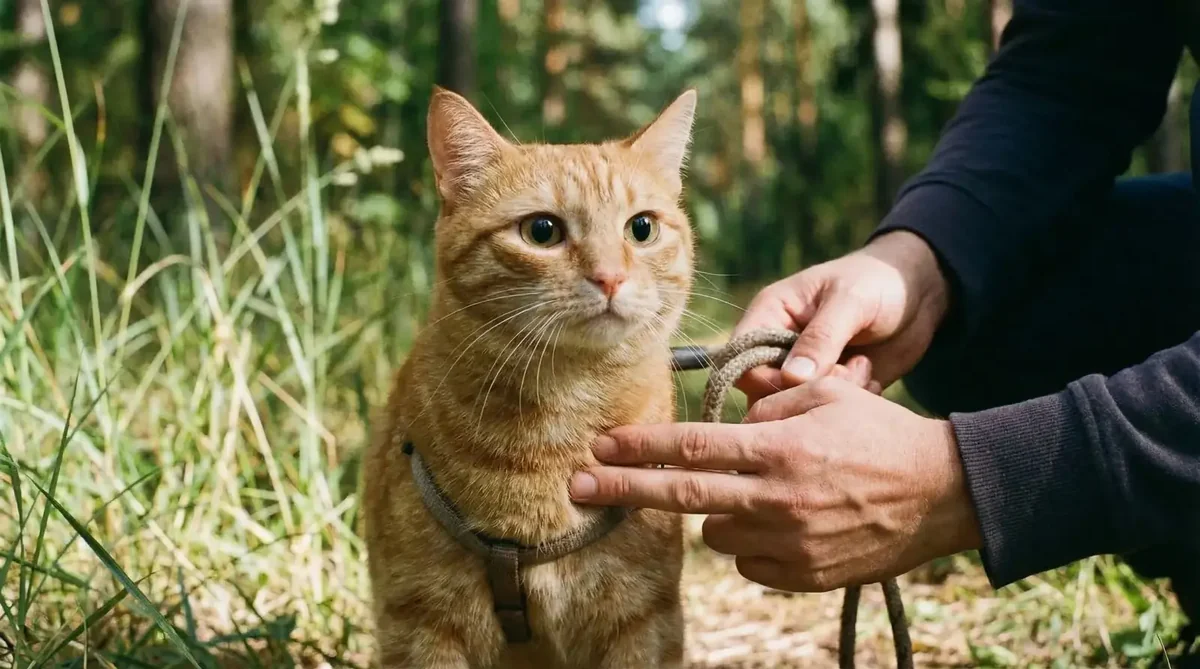
The standard check is the two-finger rule: put the harness on, then slide two fingers — stacked flat against the body — under the belly strap directly behind the front legs. Two fingers: correct fit. Three fingers: too loose, and your cat will slide her elbows right through. One finger: too tight, it’s compressing her breathing, which triggers the freeze-and-flop that owners mistake for “she’s calming down.”
The test is quick. The execution requires you to check the right spot. The belly strap behind the front legs is the critical point — not the neck loop, not the back panel. That specific location is where escapes start.
Common Fit Mistakes That Create Escape Routes
The most common mistake: sizing the harness once in a warm house in September and never touching it again. Cats change weight with the seasons — winter coats add bulk, summer inactivity drops muscle mass. A harness that passed the two-finger test in July may be a full finger too loose by December. Check it every time.
The second mistake: leaving the belly strap at the middle of its adjustable range. Harness fit requires precision, not approximation. If you’re unsure between two settings, go tighter — as long as the cat is breathing normally and two fingers fit, snug is safer than loose.
The third mistake: checking fit indoors and assuming it stays correct outside. Cats pant in heat. Their chests expand when they’re on alert. Their shoulders tense up and actively compress when they’re nervous. Check the fit on a calm cat, then re-check after five minutes outside once her muscle tension has changed.
Leash Handling: The Real-Time Skills That Prevent Escapes
Why Pulling Back Is the Worst Response When Your Cat Bolts
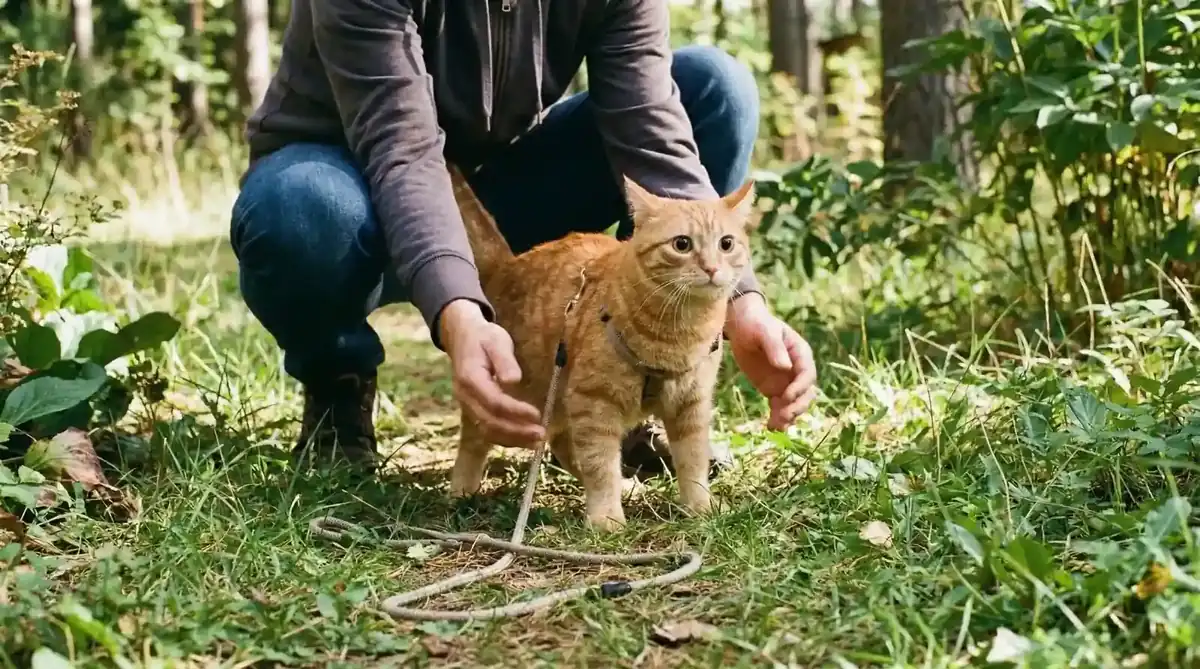
When a cat bolts, the human instinct is to pull back on the leash. This is the single fastest way to make the escape happen.
A taut backward leash gives the cat exactly the anchor she needs to work the harness off. She braces against the tension and uses it as a lever, pulling the harness forward over her compressed shoulders. The harder you pull, the more purchase she has. You are, mechanically, handing her the tool she needs.
Keeping the leash slack — specifically making sure it never goes taut in the backward direction — is not a tip. It is the baseline skill for walking any cat on a leash.
The goal is to give her nothing to pull against. This takes active management, not passive restraint.
The Yield-and-Scoop: A Step-by-Step Field Protocol
When a cat panics and starts backing up, there is a correct four-step response. It runs counter to every instinct.
Step 1 — Yield: Drop your arm and step toward her. Let the leash go completely slack — no tension at all.
Step 2 — Block: Use your body to cut off her backward path. No grabbing yet.
Step 3 — Scoop: Approach from behind, not the front. Reach under her ribcage, scoop her up, and pin her legs against your body.
Step 4 — Contain: Put her straight into a carrier or backpack. Session over. Don’t set her back down until she’s calm.
This works because it removes the mechanical advantage she needs. An untrained handler will instinctively pull back. Practice the yield until it’s automatic — because in the two seconds between a startled cat and an escape, there is no time to think it through.
Why Tethering Your Cat to a Fixed Point Is Never Safe
Tying the leash to a tent stake, a picnic table, or a tree while you walk away creates a disaster scenario. The fixed object becomes a handler who can never yield. When the cat panics and hits the end of the tether, the anchor gives maximum resistance. She backs out of the harness in seconds, alone, in an environment she can’t navigate.
The math is simple: a tethered cat has every mechanical condition needed for an escape, with no human present to stop it. At a campsite, your cat is either in active supervision with a handler who can yield — or inside a locked hard-sided enclosure. There is no functional middle ground.
If Your Cat Always Escapes: A Decision Framework
When to Keep Training vs. When to Change Your Approach
Not every cat is built for leash walking, and the evidence supports this. For a cat that has escaped multiple times despite the right gear and the right handling, the question is not “how do I make this work” — it is “what outdoor access model actually fits this specific cat.”
Four realistic options:
Continue structured training. If the cat has only escaped once or twice during early harness introduction, a gradual desensitization process is the right move. Community consensus in feline training groups lands at seven to eight short indoor sessions — under five minutes each — before most cats walk normally in a harness. If those sessions haven’t happened, the cat isn’t a Houdini. She’s undertrained.
Change the gear. If training has been done correctly and escapes keep happening, the harness design is probably the problem, not the cat. Switch from a strap harness to a full-coverage vest. A cat that reliably defeats H-style geometry may have no issues with a broad chest panel.
Switch to the backpack model. For cats that panic in new environments, a secure ventilated cat backpack gives outdoor access without the risks of leash walking. The cat gets enrichment — new sights, smells, and sounds — without being loose in an uncontrolled space. Community consensus treats this as the primary alternative for cats with chronic escape behavior.
Stop outdoor access. Some cats are genuinely not suited for outdoor exposure. 25% of lost cats are never recovered. If the risks of outdoor access don’t fit this cat’s stress tolerance, the right answer is indoor enrichment — not continued outdoor attempts that traumatize the animal and risk permanent loss.
Layered Safety: Combining Harness + Collar + GPS Tracker
For any cat going outside on a leash, the harness is the primary containment — but it should never be the only layer. 74% of lost cats are found, and most recoveries happen within a five-day window. That window is short. In wilderness areas without familiar territory, it narrows fast.
The minimum setup is: vest harness (primary containment) + breakaway safety collar with an ID tag (backup identification) + GPS or AirTag tracker (location recovery). A GPS attachment adds almost no weight and turns a temporary escape into a recoverable situation instead of a permanent loss.
Breakaway collars serve a different role here than harness buckles. On a free-moving collar, the breakaway prevents strangulation if the collar snags on a branch. That’s correct and appropriate. The collar is not the containment layer — the harness is. The collar is the identification and tracking backup that stays on if the harness fails.
| Layer | Equipment | Function |
|---|---|---|
| Primary | Vest harness, dual-closure, full chest coverage | Active containment during leash walking |
| Secondary | Breakaway collar + ID tag | Passive identification if harness fails |
| Tertiary | GPS tracker (collar-mounted or harness-mounted) | Location recovery within the critical 5-day window |
Frequently Asked Questions
How to keep a cat from slipping out of a harness?
Two things, both required: the right gear, and the right handling. Use a vest-style harness with full chest coverage, and run the two-finger test behind the front legs before every outing. On handling: never let the leash go taut backward. The moment your cat reverses, step toward her to drop the tension to zero. Backward tension is what makes every escape possible.
Do vets recommend cat harnesses?
Yes — with conditions. The 2024 AAFP guidelines on feline behavioral health recommend harness walking in quiet locations as a validated enrichment method for indoor cats. The conditions: correct fit, harness-trained before going outside, and a low-stimulation environment. A poorly fitted harness on an untrained cat in a busy area is not what the guidelines endorse.
How long does it take cats to get used to a harness?
Most cats need seven to eight short sessions — under five minutes each, with treats — before they walk normally in a harness. The freeze-and-flop you see at first is a real physical reflex, not stubbornness. You can’t rush it by forcing her to move. Cats with a previous escape scare may take longer; the bad memory has to clear before the harness can feel neutral again. See what cat training communities report.
How to safely take a cat out that always slips out of her harness?
Stop trying to fix the leash walking and change the format instead. The practical alternatives: a ventilated cat backpack (outdoor access, no escape risk), a portable pop-up catio at the campsite (contained enrichment), or indoor enrichment — puzzle feeders, active play, window perches — that addresses the energy without the risk. Given that 25% of lost cats are never recovered, a cat with a documented escape history deserves an honest look at the risk.
What’s stopping your cat from escaping the harness?
Three things, in order: precise fit, careful handling, and the right harness design. No harness is physically escape-proof against a panicking cat — the floating collarbone makes that impossible. What actually prevents escapes is eliminating backward leash tension, using a vest harness with no armpit gaps, and checking the fit before every walk. Add a GPS tracker as a backstop — because under enough stress, the primary system will eventually fail.
