
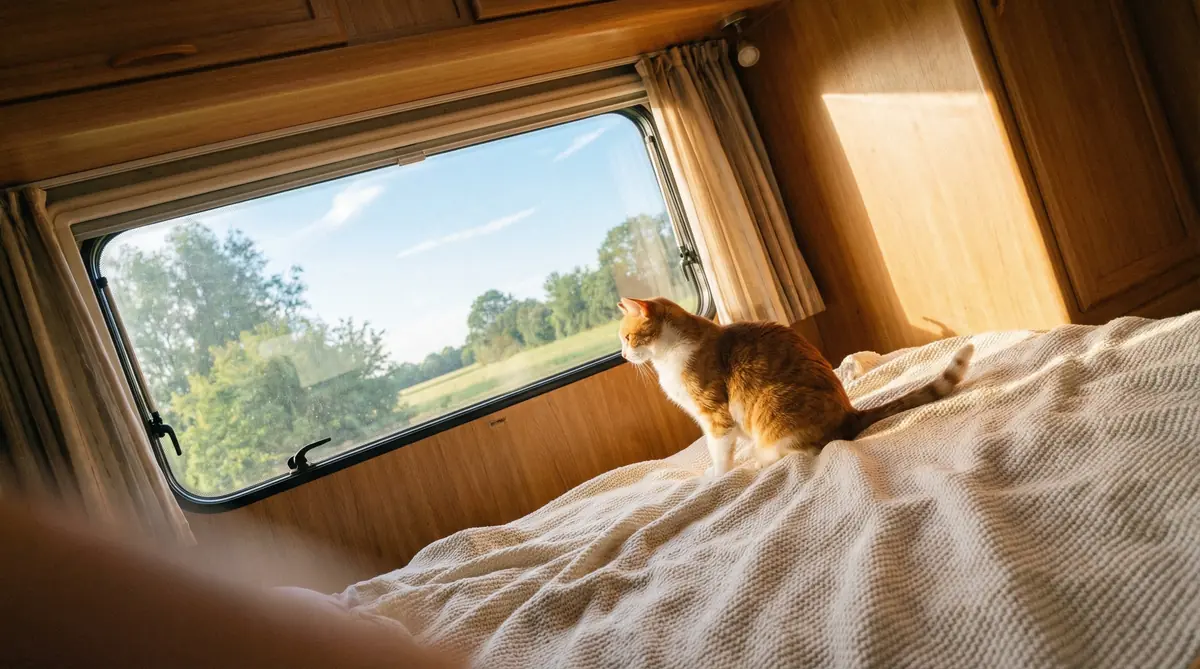
“We adopted 2 kittens almost a year ago. On the ride home from the foster they didn’t make a peep except for purring. My husband and I looked at each other and yelled ‘they are going camping!’“
Ten camping trips later, the cats have special spots to watch the squirrels. They’re being leash trained. By most measures, this is the dream.
But that dream has a specific set of conditions behind it — conditions that rarely make it into the post. The screen door reinforcement. The cellular temperature monitor. The decision framework for when it’s safe to leave them alone. The infrastructure is invisible. The cats are adorable. And that gap is exactly where things go wrong.
Key Takeaways
- RV camping with cats works — but only if you plan for how cats actually respond to stress. Vibration, noise, unfamiliar smells, and temperature swings all trigger the same fear response as a predator encounter. The cats that thrive in RVs have owners who prepared for this before leaving the driveway.
- 59% of cats show measurable distress during transport — meaning your cat arrives at the campsite already wound up. It takes less to push them over the edge than it would at home.
- Towable RV owners have a non-negotiable rule: cats ride in the tow vehicle. Travel trailers have no climate control and no crash protection while moving. This is an AVMA safety standard, not a preference.
- The screen door will fail. Reinforce it before the first trip, not after.
Before You Leave: Setting Your Cat Up to Succeed
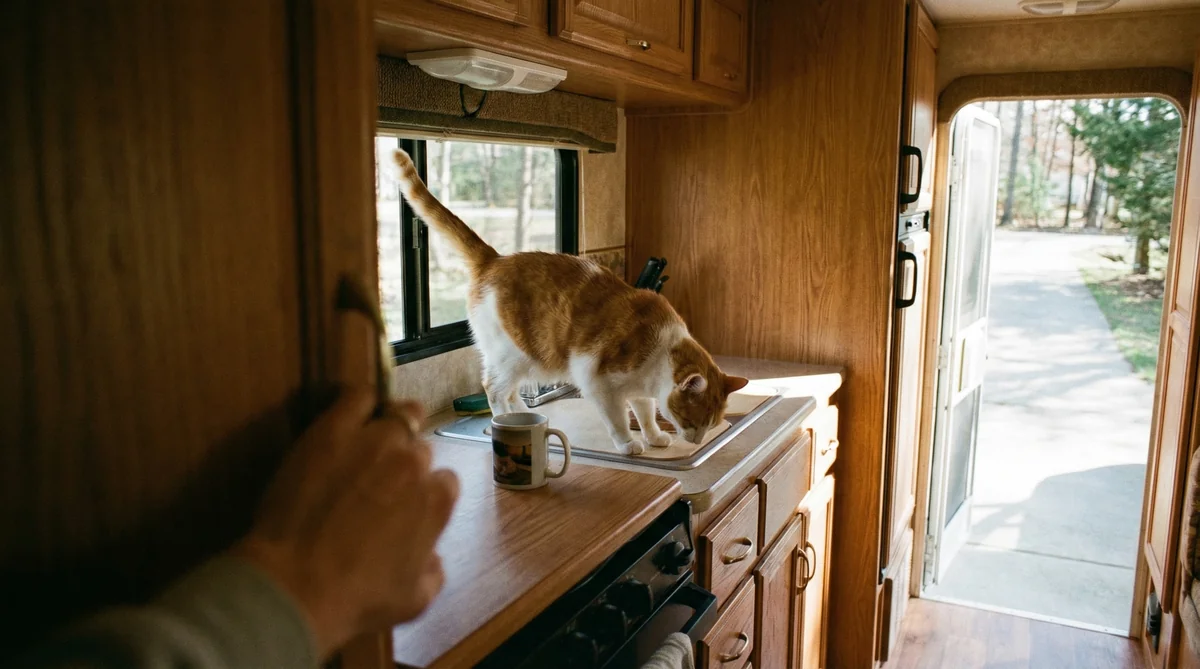
The Gradual Exposure Protocol: Parked First, Moving Second
The most common mistake in RV cat prep is mistaking “not fighting it” for “ready for it.” A cat sitting rigidly silent while the engine runs is not calm — it has gone into a freeze response. This is what prey animals do right before they bolt. Moving forward with a frozen cat doesn’t mean they’ll get used to it. It means something will eventually break.
The protocol has three phases. Each one must be completed before moving to the next.
Phase One — Stationary familiarization: The RV stays parked in the driveway for one to two weeks. The cat eats, plays, and sleeps inside it. No engine, no movement. You’re done with this phase when the cat walks in voluntarily, grooms herself, eats without coaxing, and uses the litter box without hesitation. If she’s still crouching near the exit after five days, keep going.
Phase Two — Engine on, no moving: Start the engine. Sit inside with the cat. Run the AC. Let her experience the noise and vibration while the RV is still in the driveway. Some cats settle quickly; others need several sessions. The sign she’s ready: she resumes normal behavior — eating, exploring — within ten minutes of the engine starting.
Phase Three — Short drives: Around the block, then ten minutes, then thirty. End every trip back at the driveway. Offer food when you return. You’re building the association: trip ends, safety returns.
How to Know Your Cat Is Actually Ready — Not Just Tolerating It
A ready cat in a moving vehicle will groom herself, eat when offered food, and look relaxed — soft eyes, slow blinks, tail in a neutral position. A tolerating cat will be completely still, pupils wide, ears swiveling to track every sound, refusing food. This matters more than you might expect: 59% of cats show measurable distress during transport, which means most cats arrive at the campsite already stressed — not starting from a neutral baseline.
Tolerating is not a starting point you push through. When a cat is forced through repeated stressful trips before she’s ready, her stress hormones spike and her immune and digestive systems take the hit. The most common outcome is Feline Idiopathic Cystitis — chronic anxiety degrades the bladder lining. In male cats, this progresses to urethral blockage, which becomes fatal within 24 to 48 hours without emergency care.
The timeline is a biological constraint, not a suggestion.
Catifying the RV: Space-Efficient Setups That Actually Work

Litter Box Placement in Small Rigs: The Real Constraints
Cats in RVs are living in 150 to 300 square feet of shared air with their humans. The litter box isn’t just a convenience problem — it’s an air quality and behavior problem that affects whether your cat uses it consistently.
The first issue is tracking. Standard clay litter in a small rig means granules on every floor surface within hours. The second issue is ammonia buildup — in an unventilated space, the smell from a standard box becomes offensive to the cat within 12 hours, and a cat who finds the box aversive will stop using it.
The most effective solutions come from full-time nomadic cat owners. Converting under-bed storage into an enclosed litter zone — with a small access hole cut into the panel — keeps both smell and tracking out of the living space. The shower stall works as a temporary litter area during human rest time, since it’s tiled and easy to sweep. A dedicated cabinet with a carbon filter vent handles the ammonia problem at the source.
Litter type matters as much as location. Pine pellets or silica crystal litter track far less than clay and produce almost no airborne dust. Clay dust circulates through the RV’s HVAC and builds up in the cat’s lungs — a real concern in a small space where filters rarely get changed.
Hiding Spots, Perches, and Scratch Surfaces Without Sacrificing Space
Cats need to feel their back is protected and they can see the room from above. This isn’t a preference — it’s a hard-wired stress regulation mechanism. Without wall contact and elevated observation points, a cat runs a low-grade stress response continuously. The excessive meowing and restlessness that owners blame on “not liking the RV” is usually this — not a personality issue, but a biological response to having no safe anchor point in the space.
In practice: suction-cup window perches add elevated positions without drilling. Over-door hanging shelves add vertical space without floor footprint. Tension-mounted floor-to-ceiling poles work without structural damage. The single most important addition is a covered hiding box — a simple enclosed cube — placed in a corner where the cat’s back is protected on two sides. This is the cheap fix that owners consistently say was the turning point for their cat’s adjustment.
Travel Days: Keeping Your Cat Safe While the RV Is Moving
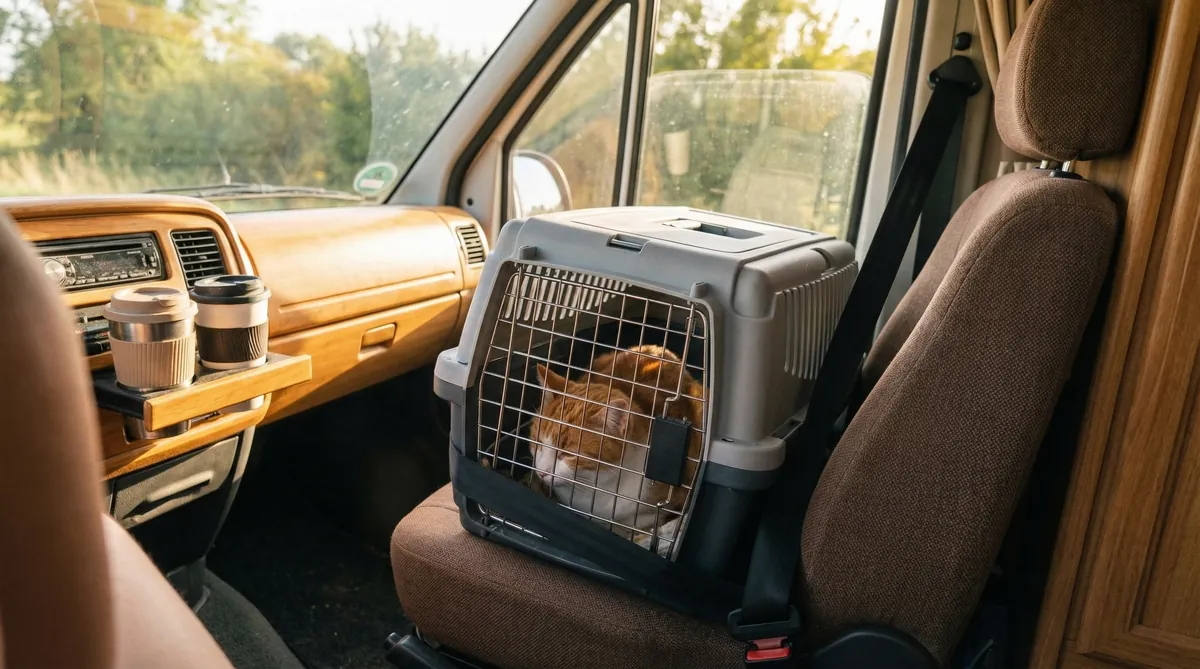
Motorhome vs. Travel Trailer: Different Rules for Different Rigs
This is the safety rule that most RV lifestyle content skips, and the gap is genuinely dangerous. The rules for traveling with cats differ completely depending on your rig type.
In a motorhome (Class A, B, or C), your cat shares the climate-controlled cab with you. Free-roaming is physically possible — but it’s also a serious safety risk. A loose cat can get under the brake pedal or become a projectile during sudden braking. The AVMA’s vehicle safety guidelines are clear: animals should be secured in carriers or restraints while the vehicle is moving. In practice: a crash-tested hard carrier secured to a fixed anchor point, not set on a seat where it slides.
In a towable (travel trailer, fifth wheel, pop-up), there’s no gray area: the cat cannot ride in the trailer while it’s being towed. No climate control, severe bouncing, no crash protection. Cats belonging to towable owners ride in the tow vehicle in a secured carrier.
| Rig Type | Cat Location During Transit | Minimum Safety Standard |
|---|---|---|
| Class A / B / C Motorhome | Same cabin as driver | Crash-tested carrier, secured to fixed point |
| Travel Trailer / 5th Wheel | Primary tow vehicle | Carrier secured with seatbelt or cargo anchor |
| Pop-Up Camper | Primary tow vehicle | Same as above |
Motion Sickness Signs, Prevention, and When to Talk to Your Vet
Cat motion sickness in RVs is driven more by stress than by the motion itself. The mechanisms behind it run through the same fear-response pathway as anxiety — which means a cat still in Phase One of acclimation will show sickness symptoms not because of the movement, but because she’s scared.
Signs to watch for: excessive drooling, repeated swallowing, vomiting, loud continuous vocalization, or total stillness with wide pupils. If these appear consistently after full acclimation, talk to your vet about Maropitant (Cerenia) for nausea and Gabapentin for anxiety. Both need prescriptions. Trial them at home before a trip — not on the road for the first time.
Prevention: withhold food six to eight hours before departure. Spray synthetic feline facial pheromone on the carrier 30 minutes before loading. Keep the cab cool and ventilated — heat makes nausea worse.
Fuel Stop and Rest Stop Safety Checks
Before opening any exterior door at a stop, know exactly where your cat is inside the rig. Highway noise, engine smells, and diesel fumes create sensory overload that can trigger an immediate bolt from an already-stressed cat. A cat that gets out at a highway rest stop has almost no chance of being found.
The protocol: look before you open. Every time.
At the Campsite: Outdoor Access, Escape Prevention, and Temperature
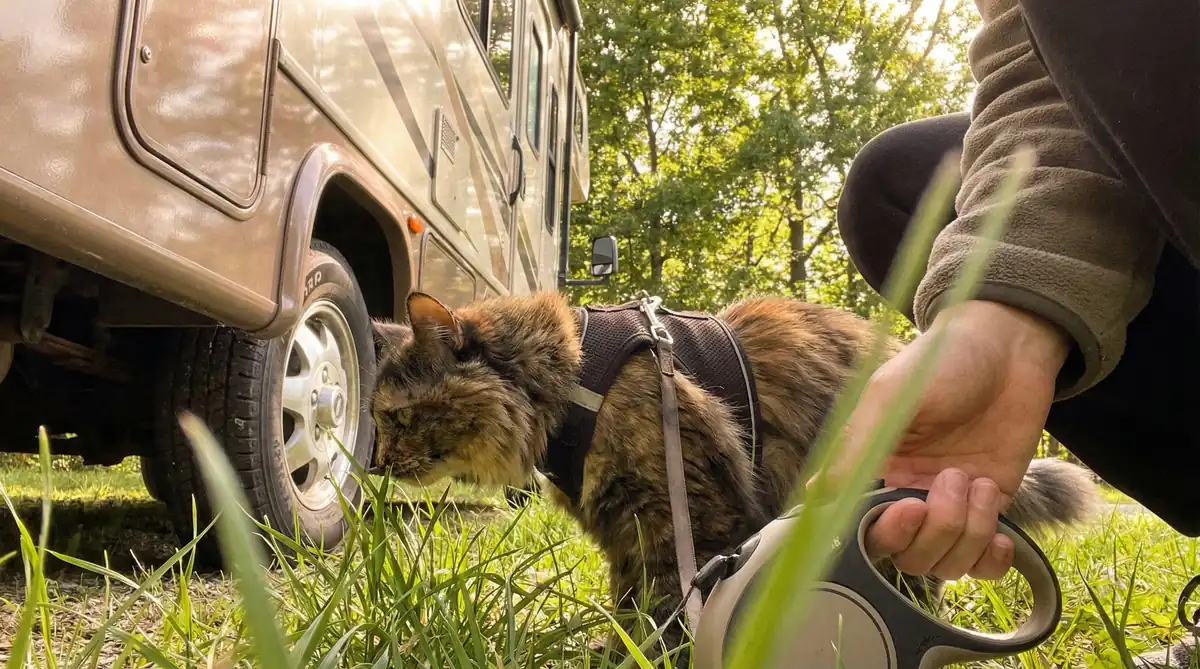
Safe Outdoor Time: Harness, Playpen, and Screened-in Options
Campground outdoor access requires the same discipline as urban leash walking — but the stakes are higher. Add coyotes, off-leash dogs, birds of prey, and unfamiliar predator scents to the equation.
The safest option is a heavy-gauge wire enclosure or metal-framed catio that attaches to the RV door opening. The cat gets outside time; you can look away. The second option is active supervision with a harness and slack leash — you must be present and paying attention the whole time. The third option, a nylon mesh popup playpen, offers almost no real security: cat claws breach the mesh in minutes, and it won’t stop an external predator.
For campsite harness use, the same escape mechanics apply as anywhere else — if your cat panics and you pull back on the leash, the tension gives her the leverage to push the harness off her body. If you’re new to managing this, the guide to stopping cat harness escapes covers the exact steps for preventing a panic bolt from becoming a lost cat.
Screen Door and Window Gaps: The Escape Routes You’re Not Thinking About
The standard RV screen door uses a flexible mesh held in place by a thin plastic spline. Under sustained pushing or climbing from a ten-pound cat, the spline pops out of the frame and creates an opening. This is the most commonly reported escape route in RV cat communities — not a hypothetical.
The fix is cheap and permanent: replace the lower half of the screen door with hardware cloth (half-inch galvanized metal mesh) screwed directly into the door frame. Under $20. Eliminates the main structural weak point.
Window gaps from partially open sliding panes are the second most common escape route. A motivated cat can push a partially open window wider. Either leave windows fully closed or install window stops that keep the gap under two inches.
Heat and Cold Management: When to Leave the AC Running
RV temperature isn’t a comfort issue — it’s a survival issue. RVs have far less insulation than houses. In direct sunlight, an unventilated rig can hit 100°F in under 20 minutes after the AC fails. That’s the lethal threshold for cats.
If your cat is inside an unattended rig in warm weather, the AC runs. This is not a judgment call.
Leaving Your Cat Alone in the RV: A Decision Framework
Temperature Is the Hard Limit — Everything Else Is Negotiable
Leaving your cat alone in the RV has one non-negotiable requirement: the interior temperature must be continuously monitored by a device that will alert you before it hits 80°F. Everything else — how long you’ve been gone, how anxious the cat gets, whether there’s enrichment — can be worked around. Temperature cannot.
The framework:
Can you leave your cat alone in the RV? Only if all four conditions are met:
1. A cellular-based temperature monitor (not WiFi-dependent) is active and reporting
2. The AC is running and has been recently serviced
3. You are within a 15-minute return radius
4. The cat has water, enrichment, and has previously been left alone in the rig without acute distress
If any condition is unmet, the cat either comes with you or the trip doesn’t happen that day.
Monitoring Tools: Cameras, Temperature Alerts, and GPS Trackers
The key distinction in monitoring equipment is how it connects. WiFi-dependent devices — most budget temperature monitors, standard security cameras — fail in exactly the scenario that matters most: a shore power outage kills the RV’s electrical system, which kills the WiFi router, which makes the monitor go dark right when the interior is starting to heat up.
Cellular monitors like Waggle run on their own 4G/LTE connection with an internal battery backup. They push alerts through the cellular network regardless of whether the RV has power. That’s the actual gold standard.
A GPS tracker on the cat’s harness adds a recovery layer: if she escapes despite all precautions, you get a real-time location instead of a search area. Most successful cat recoveries happen within five days. A GPS tracker turns an escape into a recoverable situation. Without one, it often isn’t.
What the First Trip Actually Looks Like — Managing Real Expectations
Night One Reality: What Counts as Normal Stress vs. a Real Problem
Even after thorough preparation, the first night in an RV will involve some version of this: the cat disappears into the deepest hiding spot and doesn’t come out for hours. She may refuse food. She’ll likely vocalize on and off. She may not use the litter box for the first 12 hours.
This is normal. It is not a sign that the process has failed.
Before the cat enters the rig for the first time, block off mechanical voids — under sofa slide-out mechanisms, open dashboard wiring gaps, any cavity where getting her out would require taking something apart. These are where a panicked cat will wedge herself. Extracting her in a hurry causes injury.
The line between normal stress and a real problem is behavioral, not time-based. Six hours of hiding is normal. A male cat making repeated trips to the litter box without producing anything, crouching and crying in pain, or obsessively grooming his lower belly is not normal — those are early signs of urethral blockage. The trip stops. You find the nearest emergency vet. This is the exact scenario the full acclimation protocol is designed to prevent: a cat under severe stress in an unfamiliar place is at peak biological risk for this progression.
Signs Your Cat Is Adjusting — and Signs This Lifestyle Isn’t Right for Them
Adjustment has a recognizable pattern: she starts exploring the rig on her own, plays again, eats without being coaxed, and her body language loosens up — soft eyes, slow blinks, weight shifted forward. This happens over days to weeks, not hours.
The signs that it’s not working are equally clear. If she consistently refuses food for more than 48 hours across multiple separate trips, hides persistently without improving over successive visits, or develops recurring stress-related illness (46–61.5% of cats diagnosed with FIC have repeat episodes), the honest answer is that this cat is not built for full-time mobile life.
That’s not a failure of preparation. Some cats are genuinely not suited to the constant motion and impermanence of an RV. A cat that suffers chronically in a rig deserves a different arrangement — a trusted caretaker, a stable home base, or a different travel format — not continued exposure to something causing her measurable harm.
Frequently Asked Questions
Anyone out here doing long stints with cats?
Long-term RV living with cats is well-documented and entirely achievable. The cats that do well share one thing in common: their owners completed the full gradual exposure protocol before the first extended trip and didn’t skip phases because the cat seemed “fine.” Cats that arrive at a new location already stress-primed from an unprepared first drive rarely settle into the routine that makes long stints work. The ones that do have owners who treated acclimation as infrastructure, not optional prep.
What to expect while camping with cats
Expect the first 24 to 48 hours to look worse than you hoped. Hiding, vocalization, refusing food, and litter box avoidance are all normal stress responses to being moved into an unfamiliar space. The stress response that starts during transit means your cat arrives already wound up. What separates a hard first night from a real problem is the trajectory: normal stress fades over 24 to 72 hours as routine settles in. A cat not improving after 72 hours, or showing physical symptoms — straining to urinate, repeated vomiting, refusing all food past 48 hours — needs a vet.
Do cats travel well in an RV?
Most cats don’t travel well without preparation. 59% show measurable distress during transport, so the baseline assumption should be that your cat will struggle — not that she’ll naturally adapt. Whether a cat thrives in RV life depends almost entirely on how thorough the pre-trip acclimation was and how well the rig is set up for feline needs. Cats exposed gradually to the parked and moving vehicle, with adequate hiding spots and vertical space, and managed on a consistent daily routine, can travel extremely well. Cats placed in a moving RV without preparation almost universally do not.
How can I live in an RV full-time with a cat?
Full-time RV life with a cat requires three things you can’t skip. First, a cellular-based temperature monitor with battery backup — WiFi devices go dark during power outages, exactly when you need them. Second, a reinforced screen door — the standard spline-held mesh fails under sustained cat pressure. Third, at least one enclosed, elevated perching spot where the cat’s back is protected and she can see the whole space from above. Beyond the hardware, the behavioral requirements are a consistent daily routine — same feeding times, same litter schedule — and a realistic expectation that your cat will need two to four weeks to fully settle into each new location.
How do you calm a cat in an RV?
The most effective approach addresses the underlying cause, not the symptom. Synthetic feline facial pheromone spray on the cat’s main resting area and carrier reduces stress reactivity in new environments. L-Theanine, an amino acid available without a prescription, has documented calming effects in cats. For travel days specifically, withholding food six to eight hours before departure reduces nausea, which compounds anxiety. The most effective long-term solution is the acclimation protocol itself — a cat that has good associations with the rig doesn’t need ongoing calming management. For cats with severe travel anxiety that doesn’t respond to these approaches, ask your vet about Gabapentin or Maropitant before any extended trip.
