
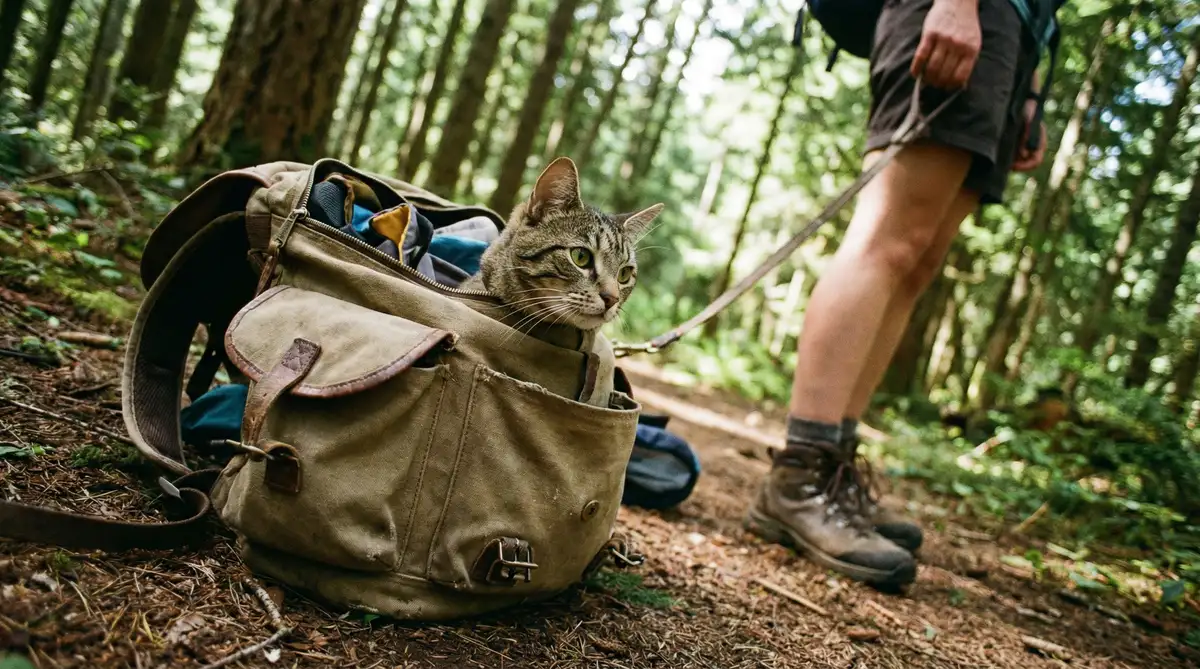
She bolted under a car at 4 AM. Gray fur, pitch-black street, invisible. Her owner chased her through a hedge lining a riverbank you couldn’t see from the path. The only thing that stopped a tragedy was a hand blindly closing around a tail.
That’s not a worst-case scenario. That’s exactly what happens when an indoor cat hits the outdoors without the right psychological preparation. Having the harness on is not the same thing as having your cat trained. These are two completely different universes.
Key Takeaways
- Cat harness training fails when owners skip the biology. The “freeze and flop” is an involuntary spinal reflex, not drama. – Vest vs H-style is a biomechanics decision, not a fashion choice. Your cat’s nervous system will tell you which one they need.
- The backpack comes before the leash. This is the step that separates cats who panic outside from cats who actually thrive there.
- A trained recall is your real safety net — more reliable than any harness the moment something goes wrong outdoors.
The Cat Harness Training Decision Nobody Gets Right: Collar vs Harness, Vest vs H-Style
Here’s a sobering number: one in 50 lost cats returns without a microchip. That tells you everything about what happens when outdoor safety fails.
A collar is never a safe leash attachment point. The feline skull is narrower than the neck — the second a cat panics and pulls backward, that collar slips right over their ears. And if it somehow doesn’t slip off, the concentrated force on the trachea during a lunge can cause severe soft tissue damage. A harness distributes that force across the chest and sternum — the parts of the body actually built to handle pressure.
But choosing the wrong harness style is the number one reason training fails on day one.
Two Designs, Two Different Cats
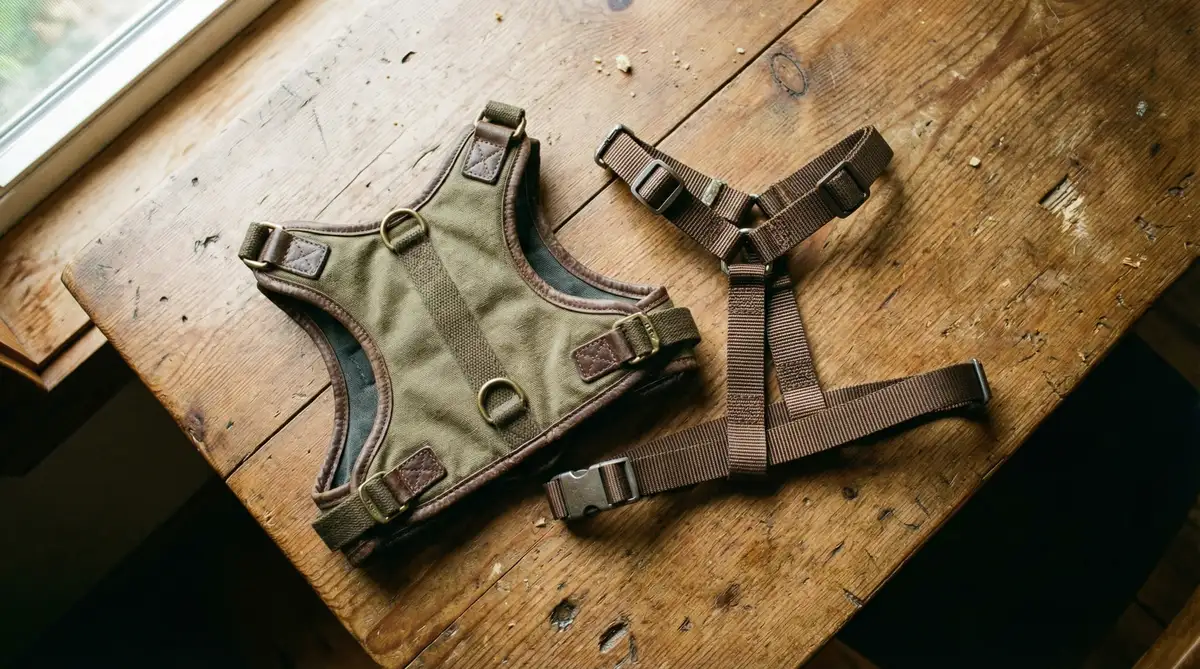
Vest-style harnesses use broad fabric panels across the chest and back, secured with Velcro and buckles. Great for escape resistance — but those chest panels often restrict the natural forward reach of the front legs. The Velcro sound near a cat’s ear can also collapse a training session before it begins.
H-style harnesses (especially Y-front versions) use thin nylon webbing with minimal contact area. Full range of motion, whisper-quiet buckles. The catch: fit precision is everything. The chest strap must be snug enough that exactly two fingers fit under it — any looser and a panicked cat backs right out.
| Feature | Vest-Style | H-Style (Y-Front) |
|---|---|---|
| Escape resistance | High — continuous fabric limits shoulder compression | Moderate to high — depends entirely on a precise fit |
| Movement restriction | Higher — chest panels can limit front leg extension | Low — full natural stride |
| Tactile sensitivity trigger | Higher surface area, more likely to cause the flop reflex | Minimal footprint, better for sensitive cats |
| Noise on fastening | Often loud Velcro | Quiet plastic buckles |
| Best for | Reactive, escape-prone cats | Active, confident cats |
And remember: tighter is not safer. Veterinary pressure testing shows that harness pressure exceeding the skin’s mechanical pain threshold actively hurts your cat, alters their gait, and poisons the training association you’ve spent time building — which is why the two-finger rule is a hard limit.
How to choose: Watch your cat’s baseline. Flinches at touch? Obsessively grooms areas you’ve handled? Panics when held? Start with H-style — less fabric means less nerve activation. Known escape artist? Explosive reaction to sudden sounds? The vest’s structural advantage outweighs the comfort tradeoff. When in doubt, H-style is the safer default — though the mechanics of why cats escape harnesses run deeper than just design.
Build the Basecamp First — Then Think About Leash Walking
Going straight from indoor harness tolerance to outdoor leash walking is a setup for disaster. Almost no one tells you this.
Cats are ambush predators, not endurance hunters. Their entire sense of safety is built on knowing their territory and having a retreat path. Drop a cat into an unfamiliar outdoor world with no established territory and no safe retreat — even a well-trained cat — and their nervous system reads it as a survival emergency. The solution is a mobile territory: a backpack your cat has already claimed as their own personal safe house.
The Backpack Is a Fortress, Not a Bag
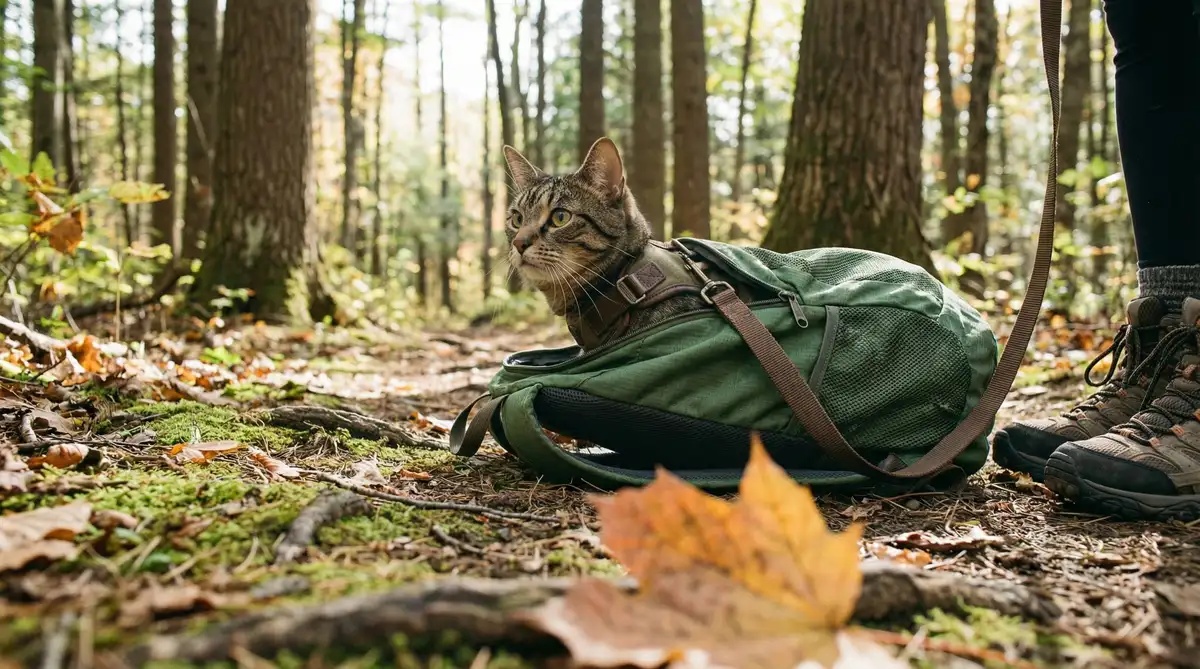
The backpack isn’t transportation. It’s a psychological anchor — the one familiar point in a sea of overwhelming stimuli. When a dog barks or a truck backfires, you want your cat’s conditioned reflex to be dive into the open backpack, not bolt under the nearest car.
One experienced adventure cat owner explained it simply: she started backpack training the moment her cat was big enough to wear a harness, pairing every trip with cooked chicken. “New places can be a bit scary for a cat,” she wrote, “so I always stay very close with the leash, ready to put her in the backpack if she starts getting spooked by something.”
How long does building that association take? Carrier acclimation takes one to three weeks — and the payoff is real: structured carrier training measurably reduces stress during transport.
How to build it: Leave the open backpack in the center of your living space for at least a week. Put their bedding inside. Drop treats in the back without prompting. Feed meals near it. Wait for the cat to voluntarily nap inside. That’s the signal it’s been claimed. For camping and RV trips, campsite safety follows the same basecamp logic.
Four Harness Training Phases — And Why Rushing Any of Them Restarts the Clock
Around 72.7% of cats successfully tolerate a harness long-term — meaning early resistance is almost always solvable. What makes it fail is pace: moving on before the cat is genuinely bored with the current phase.
Phase 1–2: From Stranger Object to Invisible Background Noise
Phase 1 is pure desensitization. No touching, no wearing. Leave the harness next to the food bowl for three to five days. Click the buckles open and closed near your cat during meals until the sound becomes genuinely unremarkable.
Phase 2 is first contact. Drape the unbuckled harness across your cat’s back for just a few seconds while they’re eating something high-value — a lickable puree works well. Remove it before they finish the treat and before any irritation appears (tail flick, skin twitch). Repeat daily, slightly longer each time, until they completely stop reacting. Only then do you buckle it.
Why Your Cat Flops Like a Dead Fish — and How to Fix It
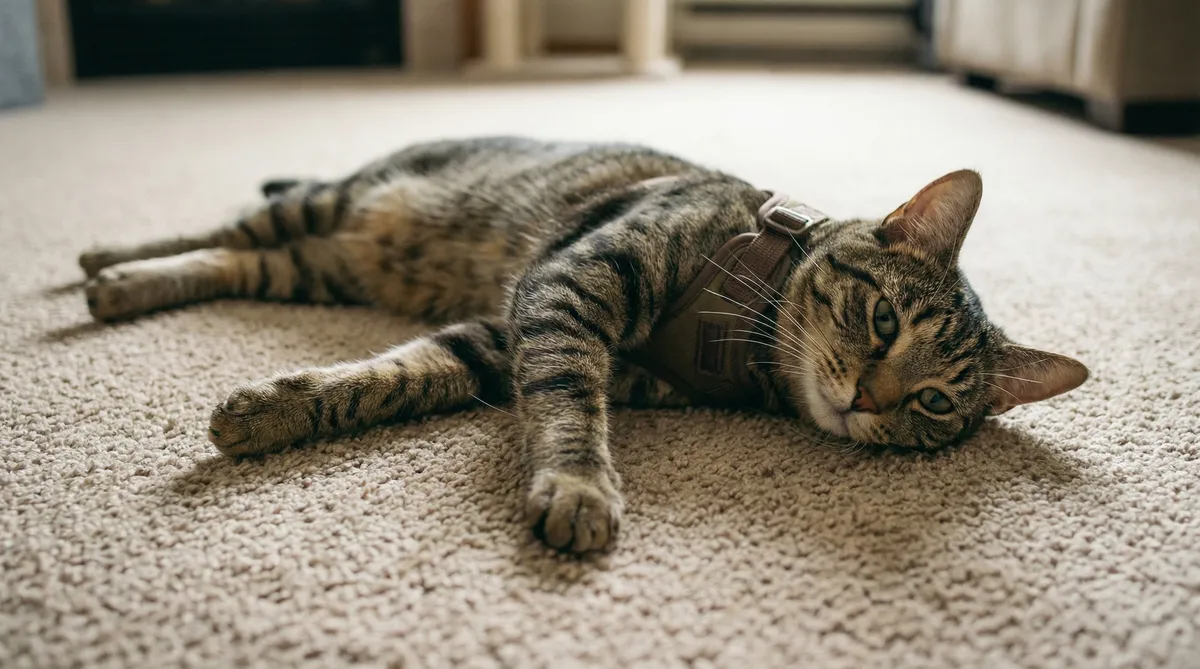
When you buckle the harness and your cat immediately drops to the floor, rolls sideways, or army-crawls across the rug — that’s not defiance. That’s neurobiology.
The harness pressure triggers pinch-induced behavioral inhibition (PIBI) — the same ancient reflex that makes kittens go limp when scruffed by their mother. Nerve endings along the spine send a signal to temporarily suspend locomotion. The harness mimics a predator’s grip, so the body freezes.
Because it’s involuntary, correcting or reassuring does nothing. What works is activating a stronger competing drive. A wand toy switches the brain from “something has me” to “something is running.” A lickable puree triggers the licking reflex, which activates the parasympathetic nervous system and counteracts stress. Your only goal is one voluntary step — once they realize their legs still work, the spell breaks and habituation accelerates.
Phase 3–4: The Leash, the Threshold, and the Lesson That Retreat Is Always Safe
Clip a lightweight fixed-length leash (4 to 6 feet) and let your cat drag it around the house under supervision. Never use a retractable leash — the constant low-grade tension triggers the opposition reflex, which is exactly what causes backward escapes.
Phase 4 is door threshold practice. Open the front door and hold the leash with full slack. Don’t pull. Don’t lure. Let your cat sit at the boundary and observe the outside from total indoor safety. The lesson you’re teaching: retreat is always available. That single concept is what makes outdoor adventuring feel manageable.
Your Cat Won’t Train for Treats — Now What?
Every competitor guide assumes your cat is food-motivated. If yours isn’t, they leave you with nothing. Here’s what actually works.
Upgrade the Reward Before You Abandon the Reward
First, rule out stress. A cat that normally loves treats but ignores them the second the harness touches them isn’t unmotivated — they’re overwhelmed. The fix is escalating the reward, not switching away from food entirely.
High-moisture lickable purees (Churu and similar) have far stronger aromatic profiles than dry treats — the smell cuts through environmental anxiety in ways kibble can’t. The licking action also provides a physiological calming effect that actively works in your favor.
If food is genuinely a dead end, activating the predatory sequence works on a different neural pathway entirely — the thrill of hunting overrides harness fear in a way that no treat can. Reserve one specific wand toy exclusively for harness sessions. That toy becomes the highest-value thing in your cat’s world.
For cats who go limp at a brush, grooming is a primary reinforcer. Use it the same way.
Finally, use biology: schedule every session 15 to 30 minutes before your cat’s normal mealtime. Natural hunger amplifies every reward without any extra effort.
The Recall Command: Your Behavioral Safety Net
No harness is escape-proof. A panicked cat with enough motivation will find the gap in any gear. Your real safety net isn’t made of nylon — it’s behavioral.
Build the Recall Indoors, Before You Ever Need It Outside
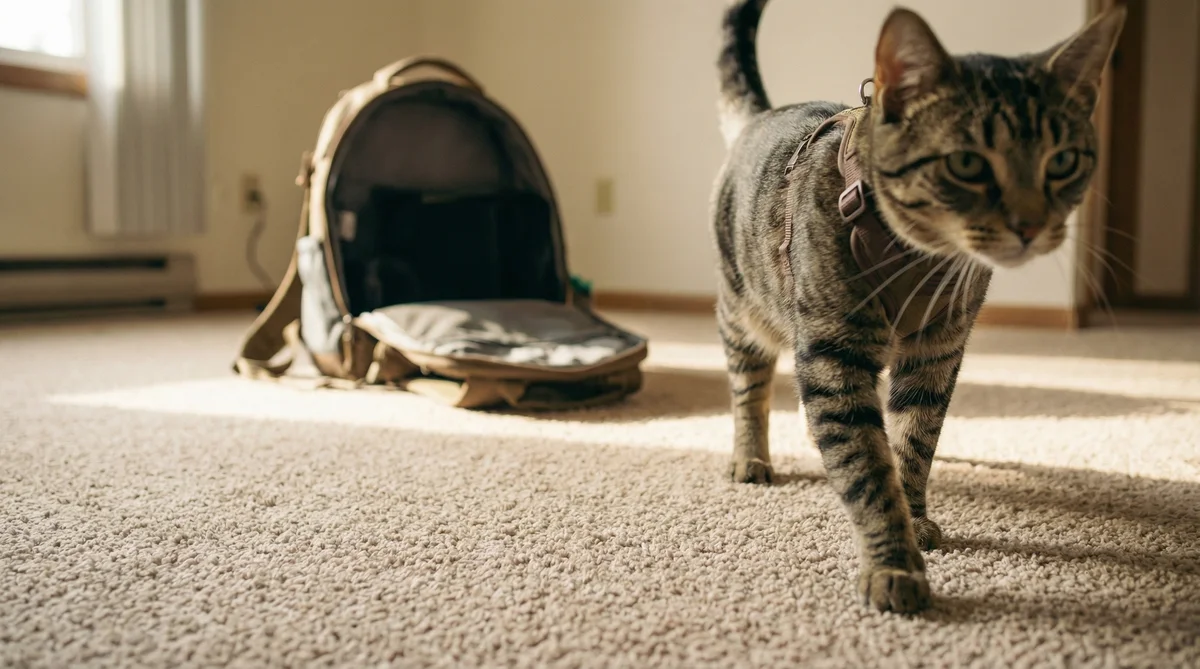
Cats are fully capable of operant conditioning — 79% of shelter cats mastered a cued behavior in controlled studies. A reliable recall is built by making one specific sound the most reliably rewarding signal in your cat’s environment.
Start in a quiet room. Pick a unique sound — clicker, tongue click, specific whistle. Sound it once, immediately deliver a high-value reward. Repeat 20 to 30 times until your cat’s head snaps toward you the instant they hear it. That’s the Pavlovian association locked in.
Add distance. Different rooms. Dead sleep. Mid-window-watching. The goal is a response so automatic it fires before conscious thought.
The masterstroke: deliver the recall reward inside the open backpack. You’ve now fused the two most critical safety behaviors — come when called, retreat to the safe house — into one fluid motion. When a dog charges on a hiking trail, that chain fires automatically.
The First Trip Outside: 10 Minutes That Can Make or Break Everything
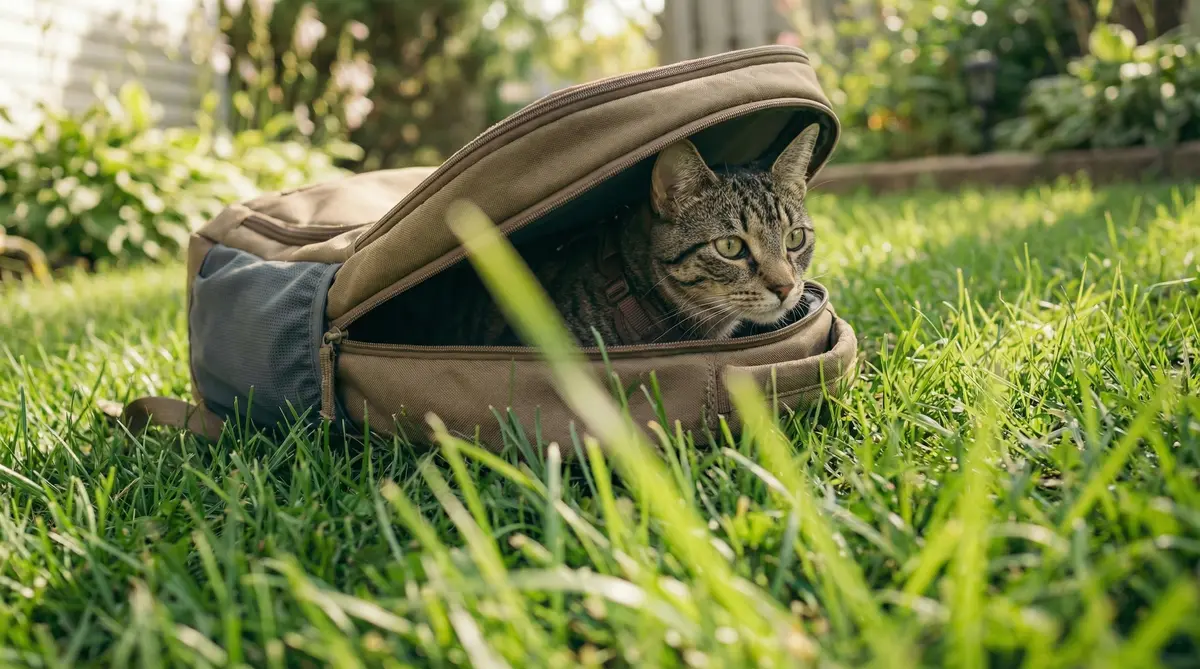
This is where weeks of patient indoor work unravel in seconds if mismanaged. The outdoor environment doesn’t care about your training schedule.
That gray cat under the car at 4 AM? She almost went into that river because her owner skipped all of this.
Before opening the door: bold, curious cats adapt best to outdoor exposure. If your cat is reactive indoors, the first trip needs to be shorter and more conservative. If they do adapt, the long-term payoff is measurable — enriched environments cut cortisol nearly in half.
Location: A quiet, enclosed, familiar space. Backyard or private courtyard. Not a park, sidewalk, or trailhead.
Time: Lowest-traffic hours — early morning or late evening.
Method: Carry your cat outside in the zipped backpack. Set it down and open the door. Do not remove the cat. Let them observe the outdoor world from inside their safe house for as long as they need. A cat that sits in the open backpack for ten minutes and goes back inside has had a completely successful first trip.
If they step out voluntarily, keep the leash slack. If something startles them, never pull toward you — rearward tension is how escapes happen. Step behind them, sound the recall cue, guide them into the backpack.
The backpack gives them somewhere to be. The recall gives them a reason to come to you. The leash is the last line of defense you hopefully never use.
Frequently Asked Questions
How long does it take for a cat to get used to a harness?
15 to 30 short sessions over several weeks — two to five minutes each. Short, positive bursts beat long sessions that exhaust your cat’s patience and deepen resistance.
What is the right age to train your cat to use a harness?
Earlier is better — kittens under a year adapt fastest. Adult and senior cats can still learn; they just need smaller steps and more patience. Age is never a disqualifier.
How do I get my cat used to wearing a harness?
Leave it near their food bowl for a few days until it’s furniture. Then drape it unbuckled on their back for a few seconds during a high-value meal. Remove it before they show irritation. Buckle it only when they’ve fully stopped reacting to the draping.
Why does my cat act so weird with a harness on?
The freeze and flop is pinch-induced behavioral inhibition — an involuntary reflex triggered by pressure on spinal nerve endings, mimicking the grip of a predator. Not stubbornness. Break it by triggering the predatory sequence with a wand toy or activating the licking reflex with a puree treat.
What do I do if my cat has no interest in treats during harness training?
Apparent food disinterest is usually stress overriding hunger. Try a lickable puree — the strong aroma cuts through anxiety, and the licking itself engages the parasympathetic nervous system. If food still fails, switch to a dedicated wand toy or grooming session as the primary reward.
