
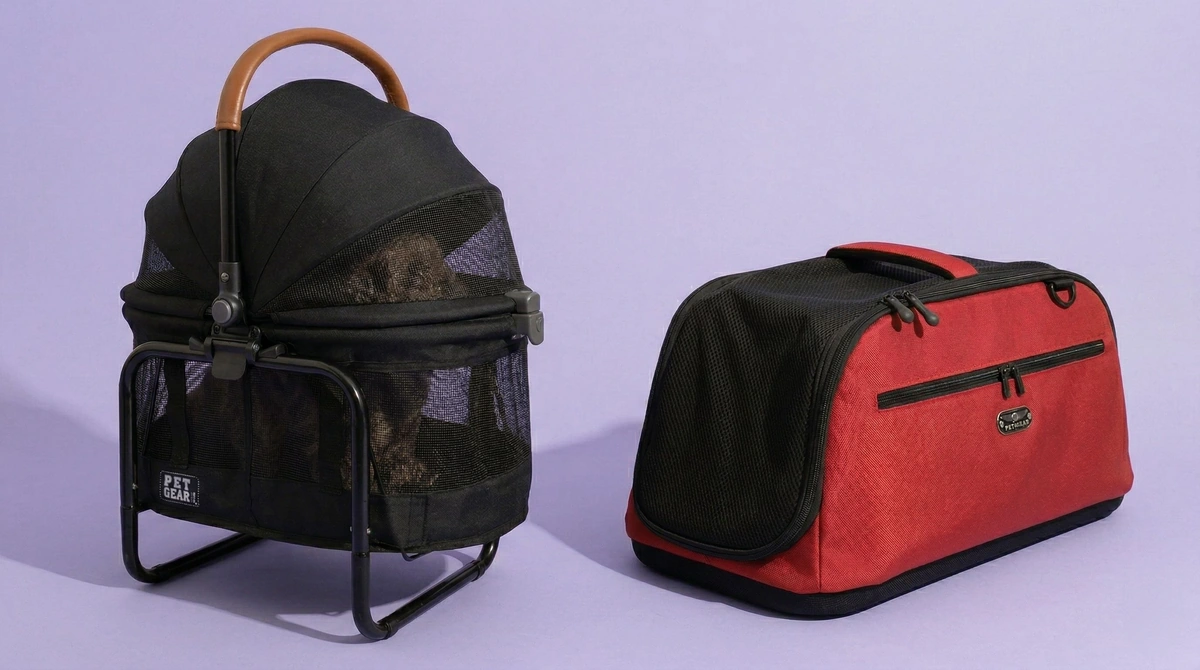
Picking a cat carrier for a long road trip shouldn’t be this hard. But search for one and you’ll hit the same wall every time: dozens of listings, all claiming to be “crash tested,” none explaining what that actually means, and prices that vary wildly with no obvious reason why.
Here’s what the research actually turns up: “crash tested” on an Amazon listing is a marketing claim with no legal definition behind it. The only organization independently verifying these claims — the Center for Pet Safety — has certified a small handful of carriers. Two of them are in this article.
Best Cat Carriers for Long Distance Car Travel at a Glance
We evaluated 15+ carriers using our five-dimension scoring system to find the five that best cover the range of needs for long-distance car travel — from the safest option for a crash to the most practical one for a large cat or a household with multiple sizes. Here’s a quick overview; we’ll go into the details on each one below.
| Product | Best For | CPS Rating |
|---|---|---|
| PawsInCar Ultimate | Overall / large cats | ⭐⭐⭐⭐⭐ |
| Sleepypod Mobile Pet Bed | Small cats | ⭐⭐⭐⭐⭐ |
| K&H Travel Safety (L) | Large cats / multi-cat | — |
| Pet Gear No-Zip View 360 | Visibility / ventilation | — |
| Petsfit 2 Side Expandable | Multi-size households | — |
PawsInCar Ultimate Car Travel Pet Carrier — Best Overall
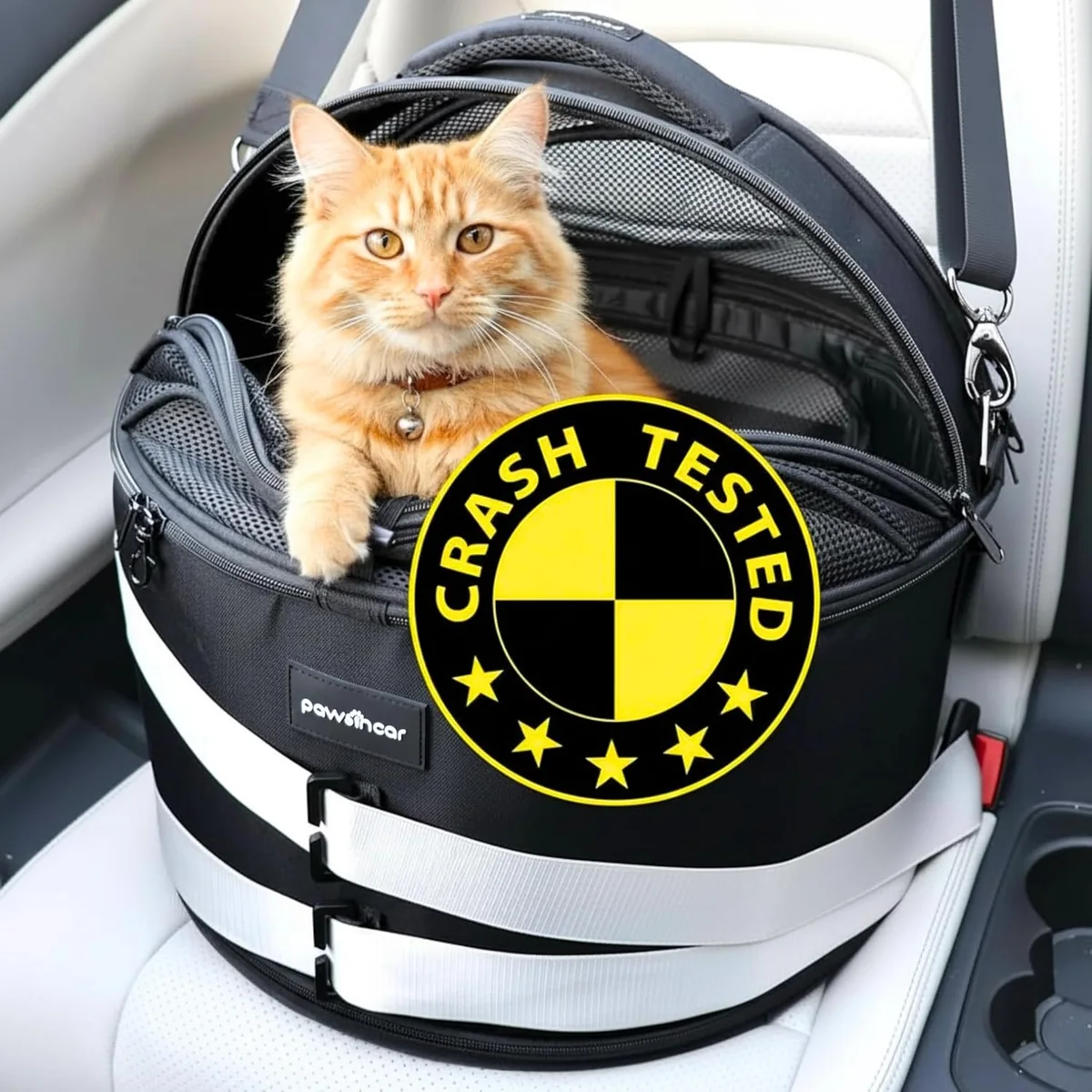
The PawsInCar Ultimate is the only carrier in this article with a 5-star CPS certification — the highest crash-safety rating available — and it’s also the only one that can comfortably fit a 22-pound cat.
| Weight limit | CPS rating | Seatbelt system |
|---|---|---|
| 25 lbs (CPS-confirmed) | ⭐⭐⭐⭐⭐ | 5-point (dual headrest straps + belt slot + non-slip base + internal tether) |
How the 5-Point Safety System Works
The PawsInCar doesn’t just thread a seatbelt through a slot and call it done. The system uses two straps looped over the headrest, a belt pass-through slot at the base, a non-slip bottom layer, and an internal tether clip for the cat’s harness. The brand calls this its “5 Protection Points” setup. In practice, it means the carrier is anchored from multiple angles instead of a single point — which matters during the abrupt deceleration of a real crash, when a single-point restraint can pivot or tip.
The internal tether attaches to your cat’s harness collar — which means the harness fit matters too. A poorly fitted harness can slip off in exactly the conditions when you need it most. CPS testing applies the manufacturer’s own installation method, so the 5-star rating reflects this specific system working as designed — not a generic carrier strapped in any old way. The test is based on FMVSS 213, the same federal standard used for child restraint systems, run at 30 mph with zero deceleration time.
Seatbelt Compatibility: Measure Before You Buy
Here’s the catch the product page won’t tell you: the 5-point system requires a rear seatbelt long enough to complete the full wrap around the carrier’s base. Guinevere reported that her car’s seatbelt was too short to route correctly — she ended up securing only the lower half.
Before purchasing, take a soft tape measure to your rear seat and check the available seatbelt length with the buckle fully extended. If it doesn’t reach around the full circumference of the carrier (approximately 42 inches), you’ll need to confirm with PawsInCar whether an extension strap is available.
Before You Buy: Plan for Cleaning
This is the most significant practical limitation of an otherwise excellent carrier. The foam liner absorbs liquid. Shredbetty, who tested the carrier with a 22-pound cat, reported that after an accident the foam needed a full two days to dry out. The bottom zipper placement makes this worse — it sits directly in the path of any drainage, which means fluids work into the zipper teeth and surrounding fabric.
For long trips, the fix is simple: lay a fitted waterproof pad or disposable puppy pad over the base before departure. It doesn’t solve the structural issue, but it keeps the foam dry for the duration of the trip. Packing a spare is worth it.
Sleepypod Mobile Pet Bed — Best for Small Cats
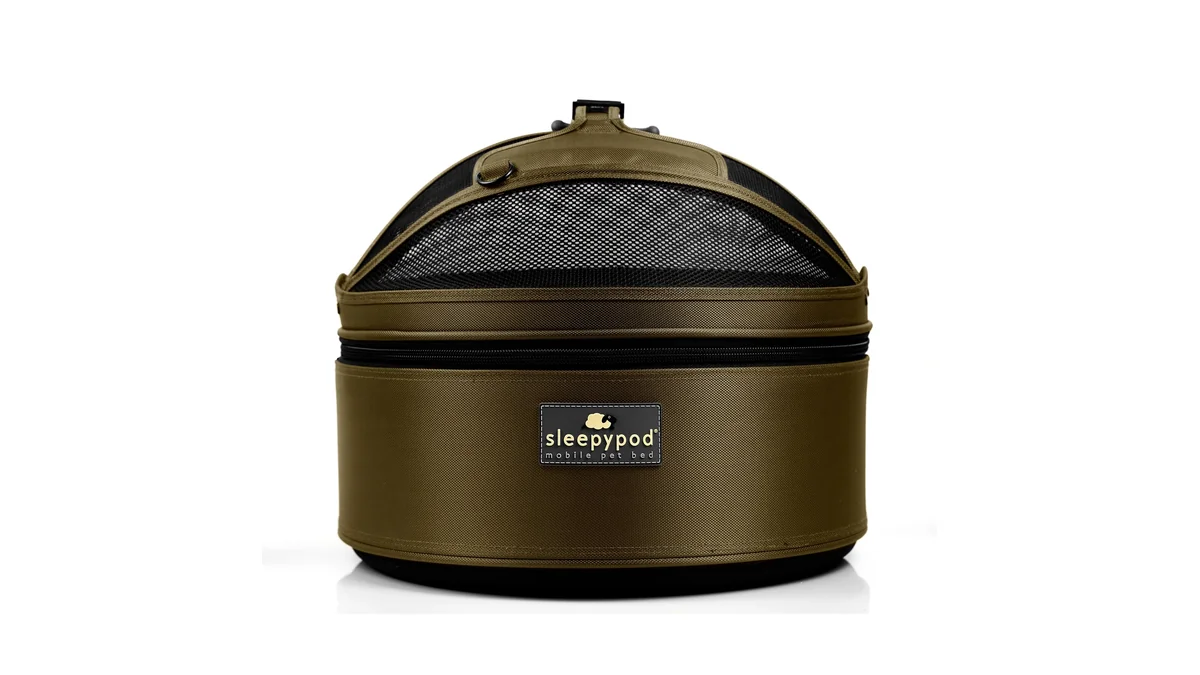
The Sleepypod Mobile Pet Bed is the only carrier besides the PawsInCar in this guide with a 5-star CPS crash rating — the highest the Center for Pet Safety awards. It’s built for small cats, and it doubles as an everyday bed, which quietly solves the hardest part of any long drive: getting your cat in.
| Weight limit | CPS rating | Seatbelt system |
|---|---|---|
| 15 lbs | ⭐⭐⭐⭐⭐ | Seatbelt threads through straps on the base |
Rated 5 Stars — Up to 15 Pounds
CPS crash-tested the Mobile Pet Bed in August 2024 with a 15-pound test dog, and it earned 5 stars: it contained the animal and stayed stable on the test seat throughout. That rating covers pets up to 15 pounds. For heavier cats, the PawsInCar (tested at 25 lbs) is the certified option.
It installs with your car’s seatbelt threaded through straps on the base. Owners consistently say it stays put under hard braking and doesn’t tip, though one found the belt too short to reach in a middle seat — check your seat before you buy. There’s no headrest strap.
Ventilation
The top half is an all-round mesh dome; the base is solid. In the 100 owner reviews we analyzed, no one reported their cat overheating — including owners on three-day drives, a 12-hour move, and cross-country trips. In summer, still make sure your AC reaches the back seat, as you would with any carrier.
Who This Is For
It suits cats up to about 12 pounds: owners of 8–12 lb cats say theirs can lie down and turn around comfortably. The dome is low, so taller cats can’t sit fully upright, and owners of 12–14 lb pets found it tight for multi-hour drives. Because it doubles as a bed, many cats were already sleeping in it before travel day — one of the simplest ways to make the drive calmer.
Two things to know before you buy. The zippers are the weak point: about 8 in 100 reviewers reported a zipper breaking or misaligning, mostly in the first few weeks, so test every zipper as soon as it arrives. And the top opening is narrow and stiff; loading a reluctant cat is easier with the whole lid unzipped.
Flying as well as driving? The Sleepypod Air is built for airline cabins, but it carries a lower 4-star CPS rating and owners report it running warm — for road trips, the Mobile Pet Bed is the better pick.
K&H Pet Products Travel Safety Carrier (L) — Best for Large Cats and Multi-Cat Travel
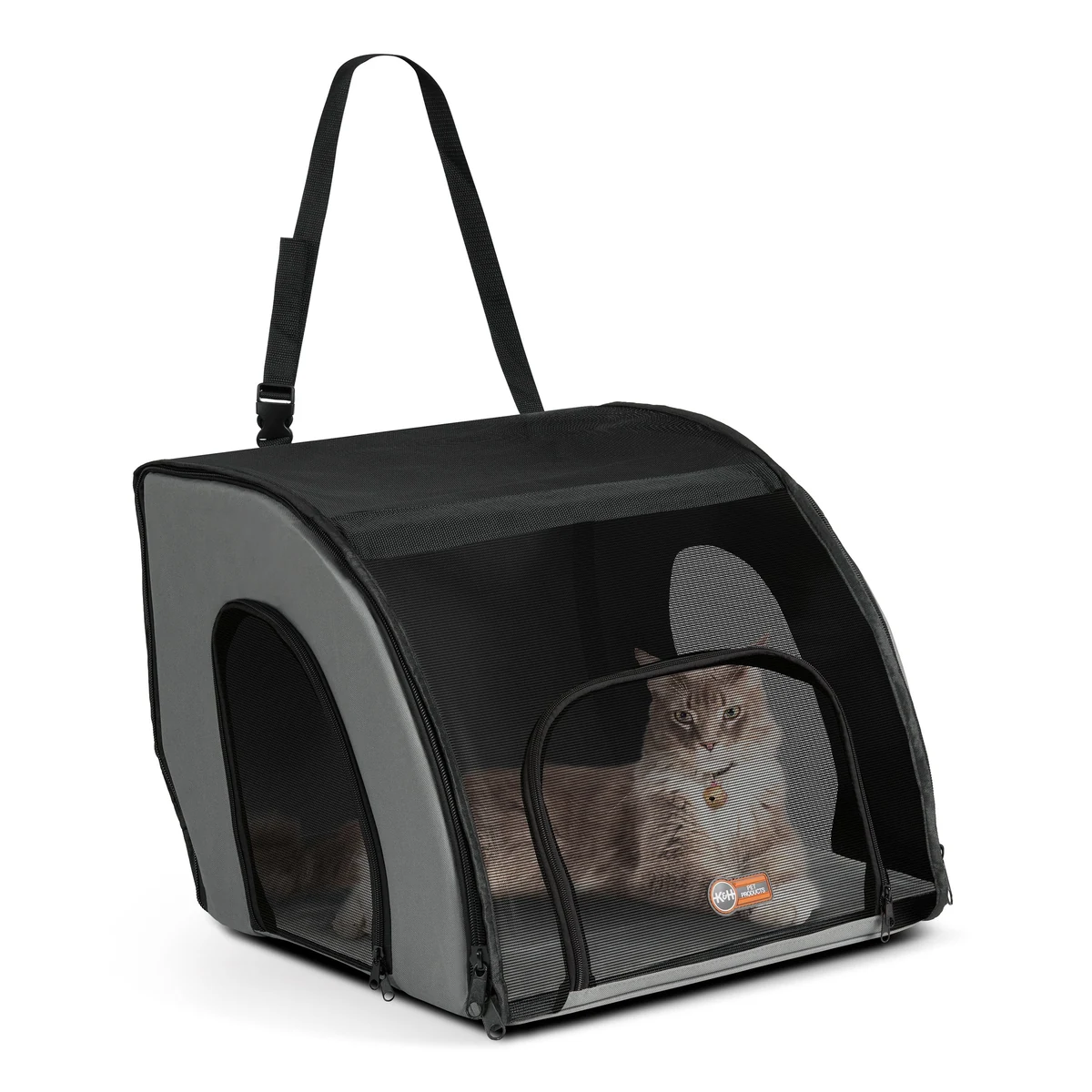
The K&H Travel Safety Carrier in L size has no crash-safety certification, but it offers more interior room than anything else in this article — and for very large cats or bonded pairs that need space, it’s the only practical option.
| Weight limit | Where it rides |
|---|---|
| 40 lbs | Cargo area or folded-down rear seat; too big for the footwell |
One Large Carrier vs. Two Small Ones
If you’re traveling with two cats, you’ll face this question. The answer is one carrier per cat, always. The stress of transit can trigger redirected aggression between bonded cats, because the confinement eliminates any ability to create distance. Gulnaz reported that both of her cats jumped into the L-size independently on arrival day — great for acceptance, but they should still travel in separate carriers. The K&H L is large enough for one big cat or one medium cat with a small travel litter insert.
Which Cars Actually Fit the L Size
The L is 29.5″×22″×25.5″. It will not fit in most sedans, and it’s tight in compact SUVs. Andrew, whose review was marked helpful by 10 people, reported that a 2014 Honda CR-V could not fit it. Before purchasing, measure your rear seat length, width between door panels, and floor-to-ceiling height in the cargo area if you’re considering that position instead. SUVs and minivans with the rear seat folded are the primary use case.
One thing worth knowing: K&H markets this carrier for dogs, not cats. The feline use records here come from actual cat owners — Gulnaz’s documentation is the most thorough — not from any manufacturer claim.
One Thing to Watch in Summer Heat
Derek O. reported that Virginia summer heat caused the plastic support rods to deform and warp. Multiple independent users across the review record report the same support rod failure, and no one found an official fix. Don’t leave this carrier in a parked car in direct sun for extended periods. If you’re camping or making long stops, move the carrier out of the vehicle or into shade.
Pet Gear No-Zip View 360 with Booster Seat Frame — Best for Visibility
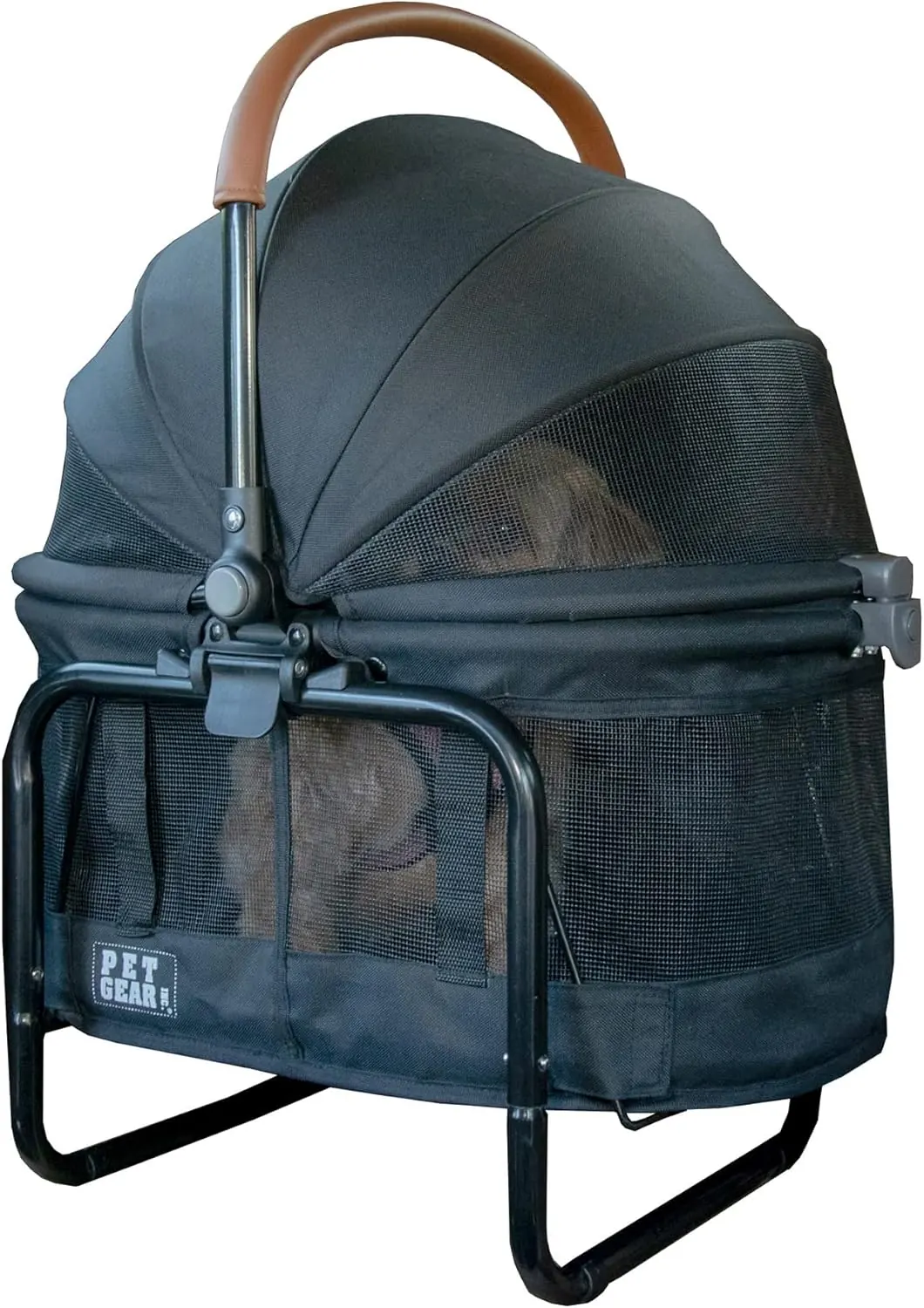
The Pet Gear No-Zip View 360 has the best ventilation and among the largest interior dimensions of any non-certified carrier here — but it isn’t crash-certified, and its booster seat frame has a documented clasp failure at highway speed. Use the carrier on its own, on the floor behind a front seat.
| Weight limit | Where it rides |
|---|---|
| 25 lbs | Floor behind a front seat, without the booster frame |
What Zipperless Entry Means in Practice
The no-zip design uses a wide-opening flap secured by a pressure clasp instead of a zipper. For cats that resist being pushed through a small zipper opening, this is a significant quality-of-life improvement — the opening is large enough to set the cat in from above, which is often less stressful. Chris, whose review was marked helpful by 24 people, reported that both of his cats accepted the carrier willingly and that the wide view reduced visible anxiety during trips.
Jennifer Kerber verified that a 10-pound and a 15-pound cat could both sit and turn around completely inside — though again, traveling two cats together isn’t recommended.
Why the Latch Matters at Highway Speed
This is a design-level failure, not a quality control issue. The Booster Frame’s connection clasp has no secondary locking mechanism — it relies on friction and pressure alone to stay closed. At highway speed, that’s not sufficient.
A reviewer identified only as “Customer” documented that at 75 mph, the clasp released, the carrier tipped sideways, and the cat was thrown inside the carrier onto its side. The reviewer described it as “could have been a disaster.” Delaney and RoGo independently reported the same failure — the clasp releasing during normal highway driving.
Sigi summarized it directly: “Seriously doubt the seat belt clamps would remain secure in an accident.”
That’s the risk of mounting any non-certified carrier on a seat. The American Association of Feline Practitioners recommends securing non-certified carriers on the floor behind a front seat instead, and that’s how we’d use this one: leave the booster frame out of the car and fit the carrier into the rear footwell.
Who This Is For
Cats that run hot or get anxious in enclosed carriers, where ventilation and a wide view matter more than crash-rated restraint. Measure your rear footwell before buying, since the carrier needs to sit on the floor. If you want certified crash protection, choose the PawsInCar instead.
Petsfit 2 Side Expandable Pet Carrier — Best for Multi-Size Households
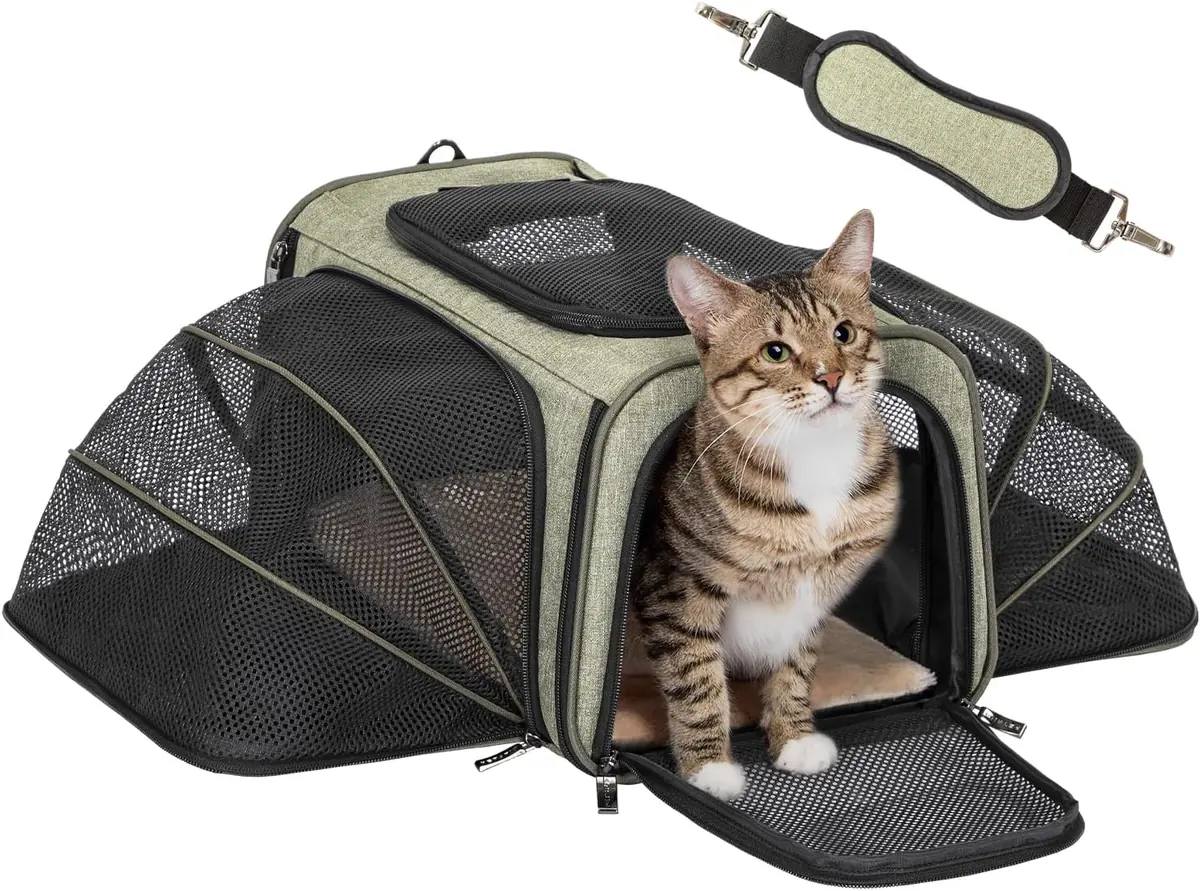
The Petsfit 2 Side Expandable is the only carrier in this article available in S, M, and L sizes — which makes it the default choice for households with cats of different sizes who need separate, properly fitted carriers.
| Weight limits | Where it rides |
|---|---|
| S: 9 lbs / M: 15 lbs / L: 20 lbs | Floor behind a front seat |
How Side Expansion Works in a Car
Each side panel unzips to create a small “room” that extends the usable interior. At rest stops, this gives your cat extra room to stretch, or space for a small litter insert.
The catch is structural: several users reported that when the sides are expanded, the frame sags inward because the rigid panels don’t lock in an open position.
Keep the Panels Closed While Driving
When the expansion panels are open, the carrier’s containment integrity depends entirely on the zipper holding around the perimeter of the expanded side. Alex, whose review was marked helpful by 2 people, reported that their cat escaped from the expanded panel during a 10-hour flight. Christina P. reported that her cat tore through the top mesh during a trip.
Keep the expansion panels closed during highway driving. Open them during rest stops, at camp, or when parked — not when the vehicle is in motion.
Sizing Guide
Use your cat’s dimensions, not its weight, to choose a size. Measure your cat’s length (nose to tail base) and standing height (floor to top of head). The carrier needs to be 1.5× your cat’s dimensions in both directions to allow natural movement.
Anjanae, whose review was marked helpful by 18 people, completed a 20-hour multi-leg transatlantic trip with the Petsfit and reported it “reliable, sturdy and secure throughout.” That’s the clearest long-distance data point in the record for this carrier.
Full Side-by-Side Comparison
| Product | Weight Limit | Where It Rides | Ventilation | Washable Liner |
|---|---|---|---|---|
| PawsInCar Ultimate | 25 lbs | Belted to the seat with its 5-point system (CPS 5-star) | 360° mesh + fan pocket | ❌ Foam; 2-day dry time |
| Sleepypod Mobile Pet Bed | 15 lbs | Seat, with seatbelt straps on the base (CPS 5-star) | Mesh dome (top half) | ✅ Machine wash |
| K&H Travel Safety (L) | 40 lbs | Cargo area or folded rear seat | 3-panel (front + sides) | ⚠️ Removable, hand wash only |
| Pet Gear No-Zip View 360 | 25 lbs | Floor, without the booster frame | 360° single mesh | ✅ Fleece, machine wash |
| Petsfit 2 Side Expandable | 9–20 lbs | Floor behind a front seat | Top + 2 sides | ✅ Plush pad, machine wash |
Products We Evaluated But Didn’t Recommend
Petseek Extra Large Cat Carrier performed well on space and ventilation — comparable to the K&H L. The reason it didn’t make the final list is a chemical off-gassing problem that multiple users independently documented and that no amount of ventilation resolved. Jess’s review recorded the smell persisting for over a year. On top of that, Ally P. and S.J. Brown both reported structural support rods falling out during trips, and Carolyn — whose review was marked helpful by 36 people — documented her cat biting through the zipper and escaping during a 22-hour journey.
Pet Gear No-Zip View 360 with Booster Seat Frame ranked highly enough on overall score to make the top five — and it did, as our Best for Visibility pick. The booster frame’s clasp issue isn’t a one-off quality problem; the clasp has no locking mechanism by design, and multiple owners hit 75 mph before finding out. If you buy it, skip the frame and keep the carrier on the floor.
Sherpa Travel Original Deluxe has the largest review count of any product we looked at (8,432 reviews, 4.5 stars) and offers genuine multi-size coverage. The problems are consistent across users: the M-size weight limit of 16 lbs excludes most adult male cats, the mesh tears easily under persistent scratching (Kyle Fake, jenniferlo99, and Simone reported independent incidents), and the plastic support rods consistently work through the outer fabric — Tugg Johnson documented this happening on three separate purchases. It’s the right carrier for a calm, small cat on a short trip — not a long road trip.
Lollimeow Pet Rolling Carrier is a well-designed airport and hotel product. The rolling frame handles great in terminals. In a car, its weak points show: the Velcro floor panel loosens over time (Kelli and Peggy both documented this), and the mesh that failed under 10 lbs of dog pressure in at least one case, it’s not appropriate for long-distance car travel as a standalone product.
How We Evaluated These Carriers
We started with a pool of 15+ carriers that appeared in search results, Reddit recommendations, and veterinary advice threads for long-distance car travel. From there, we narrowed to 9 candidates worth deep research — products with enough real-world review volume to draw conclusions from, covering the full price range and covering different use cases (certified safety, large cats, multi-cat, budget).
For each of the 9, we went through Amazon reviews systematically, cross-referenced Reddit threads and forum posts, and verified key specs — weight limits, seatbelt systems, CPS certification status — against original sources rather than product listings. That’s where the 640+ review figure comes from.
We evaluated each product across five dimensions: crash safety, in-car restraint design, interior space, ventilation, and cleaning ease. Crash safety carries double weight, because it’s the one dimension where failure isn’t recoverable with a workaround. Everything else — a liner that’s hard to clean, ventilation that’s merely decent — can be managed. A carrier that becomes a projectile in a crash cannot.
The five products with the highest weighted scores are in this article. The others are in the Products We Evaluated But Didn’t Recommend section.
What CPS Crash-Testing Actually Tests — And What It Doesn’t
The Center for Pet Safety runs a dynamic sled test based on FMVSS 213 — the same federal standard used for human child restraint systems. The carrier is secured on a test bench using the manufacturer’s exact installation method, then subjected to a 30 mph impact with zero deceleration time. It does not test how your specific car’s seatbelt interacts with the carrier, side impacts, or rollover scenarios. It’s the most rigorous independent standard available — but it tests one crash type, one installation geometry, one test weight.
CPS 4-Star vs. 5-Star: What the Difference Means for Your Cat
A 5-star means the carrier stayed completely stable and contained the dummy perfectly throughout the impact sequence. A 4-star means the carrier contained the dummy but exhibited minor dynamic movement — like lifting slightly off the test bench at peak impact. Both ratings indicate the product passed. Neither allows the animal to become a projectile. The gap matters most at higher weight loads and higher speeds, where any additional movement creates more risk.
Why “Crash Tested” on an Amazon Listing Doesn’t Mean What You Think
There is no federal regulation requiring pet carriers to pass any safety standard whatsoever. Manufacturers can conduct their own internal tests, set their own pass/fail criteria, and call the result “crash tested.” The only independent third-party verification for soft-sided carriers in the US market is the CPS certified directory at centerforpetsafety.org/cps-certified/. If a product isn’t on that list, the “crash tested” claim is self-reported and cannot be independently verified.
Frequently Asked Questions
Where is the safest place to put a cat carrier in a car?
The safest location for a non-certified carrier is the rear floorboard, directly behind the driver or passenger seat. Wedging it in the footwell restricts forward movement during sudden braking and keeps the carrier below airbag deployment zones. The American Association of Feline Practitioners gives the same advice, and adds that seatbelts should only be used with CPS-certified carriers, because a seatbelt can crush one that isn’t. If you’re using a CPS-certified carrier with a specific seat-mount system, follow the manufacturer’s installation instructions exactly.
Do I need a crash-tested carrier for long car travel?
For a long highway trip, yes — and here’s why it matters more than people expect. A standard carrier becomes a projectile in a 30 mph collision: a 15-pound cat can generate 300 pounds of force at impact. Only a short list of pet travel carriers have passed independent CPS crash testing, and two of them are in this article. The “crash tested” label on most Amazon listings is self-reported and unverifiable.
What size cat carrier do I need for a long road trip?
The carrier should be 1.5× your cat’s physical dimensions — not your cat’s weight. Measure your cat’s length (nose to tail base) and standing height. The carrier must allow the cat to stand without its head touching the ceiling, complete a full turn, and lie flat. For trips over four hours, the carrier should also accommodate a small travel litter insert.
Why doesn’t the max weight on a cat carrier tell me if my cat will fit?
Weight tells you nothing about body shape. Two 15-pound cats can have shoulder heights that differ by three inches — and the taller one may not be able to stand in a carrier that technically “supports” its weight. The Sleepypod Mobile Pet Bed is rated for 15 lbs, but owners of 12–14 lb pets found it too tight for long drives, because the low dome limits headroom.
How do I keep my cat calm in a carrier during a long drive?
Leave the carrier out at home with the door open for at least two weeks before the trip — let your cat use it as a den. On travel day, spray a synthetic feline facial pheromone (like Feliway) on the bedding 15–30 minutes before loading, and drape a breathable towel over the sides to reduce visual stimuli. Research confirms that synthetic feline facial pheromones reduce transit-related stress behaviors when applied to carrier bedding before loading. The same gradual desensitization logic that works for harness training applies here: repeated short exposures with positive reinforcement, not a cold plunge. For cats with severe anxiety, ask your vet about gabapentin — it’s widely prescribed for cat travel anxiety and significantly more effective than OTC calming supplements.
How long can a cat stay in a carrier while traveling?
Most healthy cats can handle a full 8–10 hour driving day in a carrier, as long as you stop every few hours to offer water and a litter box. A healthy cat usually pees only every 12–24 hours, so the real limit is stress, not bladder. If the trip runs longer than about 10 hours, split it over two days.
How do I travel with a cat in a car for 12 hours?
If you can, split it into two days: 12 hours pushes past the 8–10 hour window most cats handle well. If it has to be one day, use a carrier your cat can stand and turn around in, pull solid food 3–4 hours before you leave, and offer the litter box only at rest stops with the car doors closed, because cats won’t use one while the car is moving.
